 Crawllexa
Social media marketing is how a business uses platforms like Instagram, Facebook, TikTok, YouTube, LinkedIn and Pinterest to reach people, build trust and win customers. It covers the posts you publish, the conversations you have, the ads you run and the creators you work with.
It’s also the part of marketing where advice ages fastest. Feeds change how they rank posts, ad tools become more automated, and the rules on paid partnerships tighten every year. This guide sticks to what the platforms, regulators and independent researchers actually say, and turns it into decisions a small or growing business can make: which platforms to use, what to post, when to pay, what the rules require and how to tell whether any of it is working.
The short version
- Your customers are already there. There were 5.79 billion social media user identities in April 2026, more than two in three people on Earth. In the US, 84% of adults use YouTube, 71% Facebook and 50% Instagram.
- Every feed is a prediction. Platforms rank posts by how likely each person is to value them, using signals like watch time, shares, saves and time spent reading. On TikTok, follower count isn’t a direct factor.
- Original content wins. Instagram is less likely to recommend reposts and watermarked videos, and Facebook deprioritizes accounts that mostly repost other people’s work.
- One or two platforms, done well. Choose by where your buyers spend time and what they go there to do.
- Organic builds trust; paid buys reach. In Meta’s ad auction, a more relevant ad can beat ads with higher bids.
- Label paid partnerships. The US, UK, UAE and Australia all require ads to be recognizable as ads, and the UAE also requires a permit to post them.
- Never buy followers. In the US, buying fake followers to look influential is now banned under an FTC rule, and it corrupts the signals every feed relies on.
- Social now feeds search. Search Console reports how your Instagram, TikTok, X and YouTube posts perform in Google, and YouTube is among the sites AI summaries cite most.
- Measure what matters. Tag your links so analytics can separate organic from paid social, and judge each platform by leads and sales, not likes.
What social media marketing is
Social media marketing (SMM) is the part of digital marketing that uses social platforms to reach and persuade people. In practice it has five parts:
- Organic content: the posts, videos and stories you publish on your own accounts.
- Community management: replying to comments and messages, and moderating your spaces.
- Paid social: advertising on social platforms, shown to audiences you choose.
- Creators and influencers: paid or gifted partnerships with people who already have the audience you want.
- Social listening: tracking what people say about you, your competitors and your category.
Where it fits in digital marketing
Search and social do different jobs. Someone searching already has a need and is looking for an answer. Someone scrolling hasn’t asked for anything yet. Search captures demand that already exists; social creates it, by putting your business in front of people before they search and keeping you in mind until they’re ready.
| Channel | What the person is doing | What it does best |
|---|---|---|
| SEO | Searching for an answer or a provider | Captures existing demand, and keeps working over time |
| Search ads (PPC) | Searching, often ready to act | Captures demand quickly, for a price |
| Organic social | Scrolling and following people they like | Builds familiarity and trust |
| Paid social | Scrolling | Reaches chosen audiences who haven’t searched yet |
| Reading messages they signed up for | Turns interest into repeat sales |
The channels work best together. Social builds the familiarity that makes someone click your result when they do search, and search gives your social activity somewhere useful to send people. Our guides to technical SEO, on-page SEO and off-page SEO cover the search side.
Why social media matters now
The audience
According to DataReportal’s mid-2026 update, there were 5.79 billion social media user identities at the start of April 2026, up 294 million in a year. The average user spends 18 hours and 36 minutes a week on social platforms and uses 6.5 different platforms a month. One caveat matters for anyone quoting these figures: user identities aren’t unique people, because many people have more than one account.
For the US, the most reliable platform-by-platform data comes from the Pew Research Center. Its 2025 survey of 5,022 adults found that 84% use YouTube, 71% Facebook, 50% Instagram, 37% TikTok, 32% WhatsApp, 26% Reddit, 25% Snapchat and 21% X. Age changes the picture sharply: eight in ten adults under 30 use Instagram, against 19% of those 65 and older. YouTube and Facebook are the only platforms Pew asked about that a majority of every age group uses.
Social is becoming search
Social platforms are no longer just feeds. People search inside them, and their content increasingly shows up in search engines and AI answers:
- Your posts can perform in Google. In July 2026, Google made platform properties available to everyone in Search Console. They show how your posts on Instagram, TikTok, X and YouTube perform in Google Search, Discover and Google News, including the search queries that lead people to them.
- Pinterest works like a search engine. Pinterest’s own distribution guidance asks for relevant keywords in Pin titles, descriptions and board titles, and notes that a Pin can keep gaining engagement for months, or even years.
- Video feeds AI answers. YouTube is among the sites Google’s AI summaries cite most often, according to Pew. Our guide to AEO and GEO covers how AI answers choose their sources.
How platforms decide what people see
Every feed is a prediction. There are far more posts than anyone could see, so each platform ranks them by how likely each person is to value each one. The platforms publish more about how this works than most marketers realize.
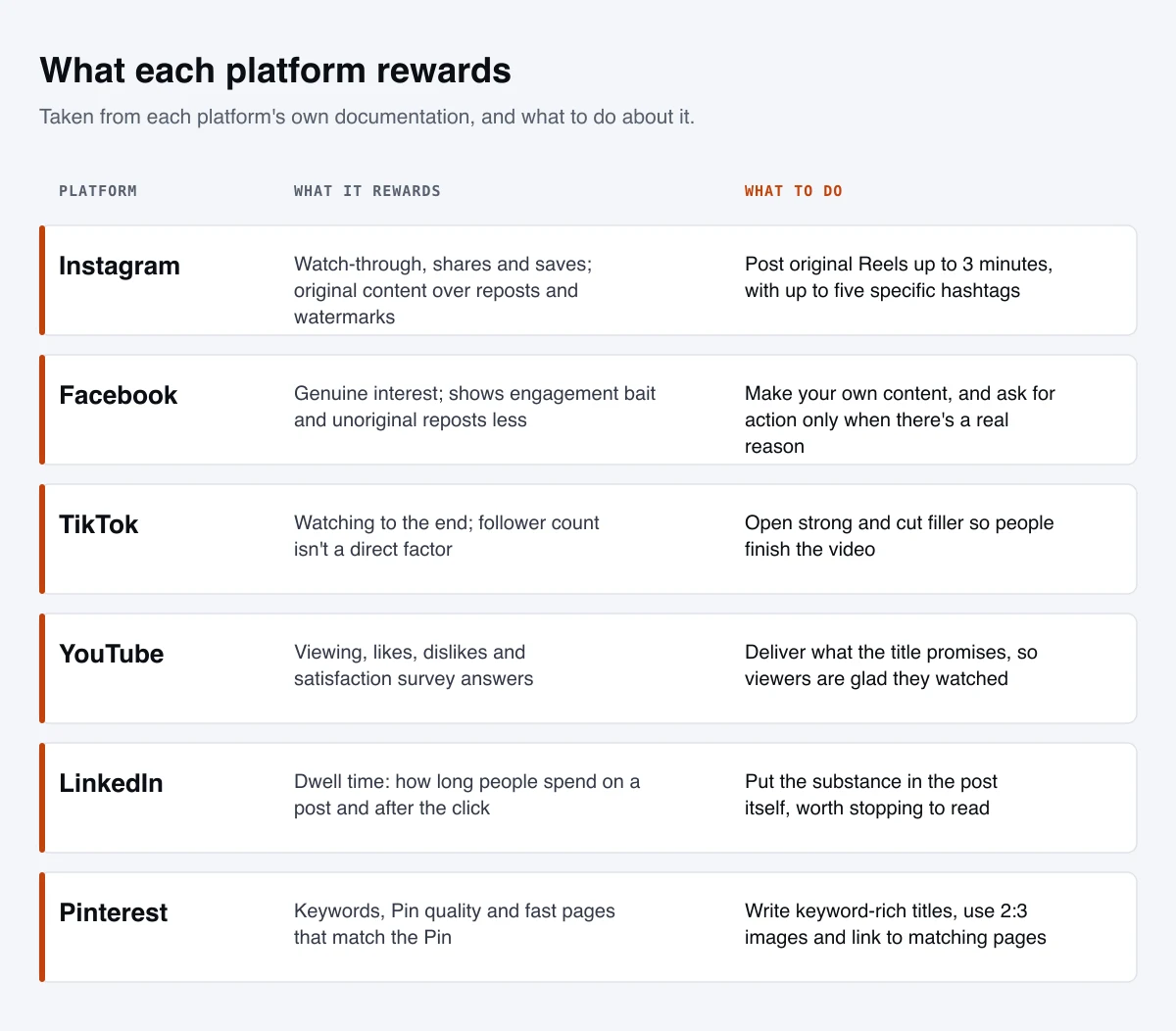
Instagram doesn’t have one algorithm. According to Adam Mosseri, the head of Instagram, each part of the app, including Feed, Stories, Explore, Reels and Search, ranks content its own way. What it predicts differs by surface:
- Feed: how likely you are to spend time on a post, comment, like, share or tap the profile.
- Stories: whether you’ll tap into a story, reply to it or skip to the next.
- Explore: likes, saves and shares.
- Reels: reshares, watching all the way through, likes and visits to the audio page.
Instagram is also explicit about what it holds back. It’s less likely to recommend reposts of Reels already on Instagram, content with noticeable watermarks, and accounts that mainly collect and reshare other people’s content. Posts that break its Recommendation Guidelines are still shown to your followers but not recommended to non-followers in Explore, Search or Reels; your Account Status shows whether that has happened. To be recommended at all, a Reel must be three minutes or shorter.
Since December 2025, Instagram has capped posts and Reels at five hashtags, saying fewer, more targeted hashtags work better than many generic ones.
Facebook publishes the types of content it shows less of. One is engagement bait: posts that explicitly ask for votes, shares, comments, tags or reactions for reasons other than a genuine call to action. “Comment YES if you agree” is the classic example. Requests for help finding a missing person, fundraising, petitions and emergency information aren’t treated as bait.
In March 2026 Facebook went further on originality. It deprioritizes unoriginal content, such as reaction videos that add nothing, clips stitched together, and re-uploads with only a new border, caption or speed. Accounts that mainly post this kind of material can be made non-recommendable and lose monetization. Facebook says views and watch time for original Reels roughly doubled in the second half of 2025 compared with a year earlier.
TikTok
TikTok’s own explanation of its For You feed names three groups of factors: how you interact (likes, shares, follows, comments and what you create), information about the video (captions, sounds and hashtags), and device and account settings like language and country. Strong signals of interest count more than weak ones: finishing a longer video weighs more than the viewer and creator being in the same country.
Two points matter most for businesses. Neither follower count nor past hit videos are direct factors in what TikTok recommends, so a new account can reach people. And since August 2025, TikTok has limited posts to five hashtags.
YouTube
YouTube’s recommendations on the home page and in the Up Next panel draw on viewing behavior, likes, dislikes, subscriptions and feedback, including answers to satisfaction surveys. The survey signal is the important one: it tells YouTube whether people were satisfied with what they watched, not just whether they clicked.
LinkedIn’s engineers have written about dwell time, the time members spend on a post. It measures time “on the feed”, once at least half of a post is visible, and time “after the click”. LinkedIn uses it because clicks, likes and comments are rare and noisy, while dwell time is available for every post. When LinkedIn used it to predict which posts members would skip, skipped posts fell and engagement rose. A post that makes people stop and read is what the feed rewards.
Pinterest ranks Pins using engagement, Pin quality, keywords and the quality of the linked site. It asks for relevant keywords in titles and descriptions, a Pin that matches its landing page, and a site that loads in under 4 seconds, and it recommends a 2:3 image ratio and fresh, original Pins every week.
What this means in practice
- Earn attention, not clicks. Watch-through on TikTok and Reels, dwell time on LinkedIn and satisfaction on YouTube all measure whether people valued a post after they started it.
- Make posts worth sharing and saving. Shares and saves are among the actions Instagram predicts on Feed, Explore and Reels.
- Post original work. Instagram and Facebook both hold back reposts and lightly edited copies of other people’s content.
- Don’t bait. Asking for comments or shares to game the feed gets posts shown less.
- Write for search inside the platform. Clear captions, titles and up to five specific hashtags tell each platform what your post is about.
- Followers matter less for reach than they used to. Instagram recommends Reels to non-followers, and TikTok doesn’t use follower count as a direct factor, so a strong post can reach beyond your existing audience.
Choosing your platforms
| Platform | US adults who use it (Pew, 2025) | Where it’s strongest | Formats that work |
|---|---|---|---|
| YouTube | 84% | How-to, reviews and explainers people search for | Long videos and Shorts |
| 71% | Broad reach across age groups, local communities and groups | Video, photos and events | |
| 50% | Visual products and services, especially under-30s | Reels, carousels and Stories | |
| TikTok | 37% | Discovery through entertainment and education | Short video |
| Not in the 2025 survey | B2B, hiring and professional services | Posts, documents and video | |
| Not in the 2025 survey | Things people plan and buy: home, fashion, food, events | Pins and boards | |
| X | 21% | News and real-time conversation | Short posts and threads |
LinkedIn reports more than 1.3 billion members worldwide; like all account counts, that isn’t the same as active users.
Choose with four questions:
- Which platforms do your buyers use? Start with age and audience data like Pew’s, then ask your customers directly.
- What do they go there to do? People open YouTube to learn, Pinterest to plan, LinkedIn for work and TikTok to be entertained. Your content has to fit that mood.
- What can you make consistently? A business that writes well can win on LinkedIn; one that can film its work can win on Reels and TikTok.
- Where does your category already have engaged audiences? Look at the accounts your buyers follow, not just your competitors.
Most small businesses do better with one or two platforms done well than with five done occasionally. Claim your business name on the others anyway, so no one else does, and link each profile to your website. Local businesses should treat Facebook and Instagram as companions to their Google Business Profile, which our local SEO work covers.
Building a social media strategy
- Start with a business goal. Awareness, leads, sales, customer support and hiring each need different content and different measures. Pick one primary goal per platform.
- Know who you’re talking to. List the questions customers ask before they buy. Sales calls, support emails, reviews and the search queries in Search Console are the best sources.
- Choose three to five content pillars. These are the recurring themes you’ll post about, for example: teaching something useful, showing your work, proof from customers, the people behind the business, and offers. Pillars keep you consistent without repeating yourself.
- Match formats to platforms. The same idea might become a Reel, a LinkedIn post and a Pin, each made for its platform rather than copied across.
- Set a pace you can keep. No platform publishes a required posting frequency, and every post is ranked on its own merits. A sustainable rhythm of good posts beats a burst of weak ones followed by silence.
- Plan and schedule. Meta’s Business Suite lets you schedule posts, Stories and ads for Facebook and Instagram and answer messages from one place, and most platforms have their own scheduling tools.
- Agree the house rules. Decide your tone of voice, who replies to comments and messages, how fast, what gets escalated, and what you’ll do if something goes wrong in public.
Creating content that performs
Make it original
Both Instagram and Facebook now reward original content and hold back reposts. If you want to use someone else’s video, use the platform’s remix or stitch tools and add something real: your own explanation, demonstration or point of view. Re-uploading with a new caption or border doesn’t count.
Win the first seconds and the first lines
On video platforms, finishing a video is a strong signal, so the opening has to tell people why they should stay. On LinkedIn and Facebook, the first lines of text decide whether anyone expands the post. Lead with the point, the problem or the result, not with an introduction.
Write for search inside the platforms
People search on every platform, and the platforms read your words to understand what a post is about. Use the terms your customers use in captions, titles, descriptions and your profile. Use up to five specific hashtags on Instagram and TikTok instead of long generic lists. Search Console’s platform properties show which Google searches lead to your posts, and Google suggests using them to shape video topics and captions.
Use each platform’s native format
- Reels and short video: vertical, with captions on screen for people watching without sound, and three minutes or less if you want Instagram to recommend them.
- Pins: 2:3 images whose text matches the page they link to.
- No watermarks: a video exported from one app with its logo showing is exactly what Instagram says it’s less likely to recommend.
- Accessibility: captions and alt text help people with disabilities and give platforms more text to understand your post.
Test before you commit
Instagram’s trial reels show a Reel to non-followers first. After about 24 hours you see its views, likes, comments and shares, compared with your previous trials, and can then share it with your followers, or let Instagram do so automatically if it performs well. It’s a low-risk way to test a new format or topic.
Skip the tricks
Engagement bait is shown less on Facebook and doesn’t improve ad performance on Meta. Clickbait can win a click and still disappoint, which is what YouTube’s satisfaction surveys and LinkedIn’s dwell time are designed to catch. Tricks that once worked now tend to work against you.
Community management
Social media is a conversation, and how you handle it is visible to everyone:
- Reply to comments and messages. A question left unanswered on a public post tells every later reader how you treat customers.
- Use one inbox. Tools like Meta Business Suite bring Facebook, Messenger and Instagram messages together, so nothing gets missed.
- Take complaints seriously, in public and then in private. Acknowledge the problem publicly, then move the details to a private message. Never share customer information in a public reply.
- Moderate. Hide or remove spam and abuse, and use keyword filters for offensive language.
- Turn praise into proof. Happy customers on social media are good people to ask for reviews, within the rules covered in our off-page SEO guide.
Paid social marketing
Paid social marketing means advertising on social platforms: paying to show chosen content to chosen people. Organic reach depends on the feed’s judgment of each post; paid reach is predictable, can target people who’ve never heard of you, and can be measured against sales.
When paying makes sense
- You need reach beyond your followers, on a schedule, for a launch, an offer or an event.
- You want to re-engage people who visited your website or engaged with your posts.
- You want to test messages quickly before investing in them elsewhere.
- You have proof something works organically and want more people to see it.
Boosting a post is the simplest form of paid social. Ads Manager on Meta, and Campaign Manager on LinkedIn, give you control over the goal, the audience, the placements and the measurement, and that control is where most of the results come from.
How the ad auction works
Every time there’s a chance to show someone an ad on Meta’s apps, an auction decides which ad they see. The winner is the ad with the highest total value, which combines three things:
- Your bid: what you’re willing to pay for the result you want.
- Estimated action rates: how likely this person is to take that action after seeing your ad.
- Ad quality: based on people’s feedback, such as hiding an ad, and on low-quality signals like withholding information, sensational language and engagement bait.
Because relevance is part of the score, Meta says a more relevant ad can win against ads with higher bids. For a small business, that’s the most useful fact in paid social: a better ad for the right audience is cheaper than a bigger bid.
Targeting after the privacy changes
Since iOS 14.5, Apple has required apps to ask permission, through App Tracking Transparency, before tracking people across other companies’ apps and websites. That made browser-based tracking less complete, and the platforms responded in two ways:
- Server-side conversion data. Meta’s Conversions API sends conversion events from your server, website platform, app or CRM directly to Meta, alongside or instead of the browser pixel.
- AI-led targeting. With Advantage+ audience, Meta’s system finds your audience from signals like past conversions, pixel data and ad interactions, treating your targeting choices as suggestions. Meta recommends testing it for almost every campaign type except retargeting, and reports lower costs per result in its own tests.
The practical consequence: with broad, automated targeting, your creative does much of the targeting. The ad’s image, words and offer decide who responds, so test several genuinely different ads instead of many versions of the same one.
Budgets and the learning phase
When you launch or significantly change an ad set, Meta’s delivery system goes through a learning phase while it works out who to show it to. Ad sets usually leave it after about 50 results in the week after the last significant edit; until then, results are less stable and usually more expensive. Meta’s advice:
- Don’t edit during learning, because significant edits restart it.
- Combine similar ad sets rather than spreading a small budget thinly.
- Use a realistic budget. If your budget can’t produce about 50 of your chosen result a week, the ad set is marked “Learning limited”. Either raise the budget or optimize for a result that happens more often, such as leads instead of purchases.
On LinkedIn, the minimum budget is $10 a day, or $100 lifetime for a new campaign, and LinkedIn suggests $25 a day for new advertisers. Actual spend can run up to 100% above the daily budget on a given day, so plan with the monthly total in mind.
LinkedIn for B2B
LinkedIn’s advantage is professional targeting. You can target by job title, function, seniority, skills, company name, company size, industry and more, with a minimum audience of 300 members. That makes it the strongest paid option for reaching decision-makers in specific roles, and it rewards tightly defined audiences and offers worth a professional’s time.
Measuring paid social
Each platform measures its own ads its own way. By default, Meta’s attribution settings credit an ad with conversions that happen within 1 or 7 days of a click, or within 1 day of someone seeing it. Your analytics tool uses its own rules, so the two will never match exactly. Meta itself advises evaluating performance in your external analytics tool if you use one. Use the platform’s numbers to compare ads with each other, and your analytics to judge what the channel is worth to the business.
Our PPC services cover paid search and paid social as one budget, so the two don’t compete for the same customers.
Working with creators and influencers
Creators can put your business in front of an audience that already trusts them. What makes a partnership work is fit, not size:
- Choose by audience, not follower count. Ask for the creator’s audience data from their platform insights: where their followers are, their age range and how their recent posts performed.
- Look for real engagement. Comments from real people about the content are a better sign than a large follower count.
- Put it in writing. Agree deliverables, timing, who owns the content and how you can reuse it, and how the partnership will be disclosed.
- Let them create. Creators know what works for their audience. A brief that dictates every word usually produces a post that looks like an ad and performs like one.
The disclosure rules in four markets
Paid partnerships have to be clearly labeled as advertising. The details differ by market:
| Market | Who sets the rules | What they expect |
|---|---|---|
| US | Federal Trade Commission | Disclose any financial, employment, personal or family relationship with a brand, including free products. Put it in the post itself, and in the video for video, using clear terms like “ad” or “sponsored”. “Sp”, “spon” and “collab” aren’t enough. |
| UK | Advertising Standards Authority | A prominent “ad” label upfront, before people engage. The ASA advises against “sponsored”, and says “gifted”, “supported by” and “in association with” are unlikely to be clear enough. |
| UAE | National Media Authority | Anyone posting ads or promotional content on social media, paid or unpaid, has needed an Advertiser Permit since 31 January 2026. The authority replaced the UAE Media Council in December 2025. |
| Australia | Ad Standards and the ACCC | Advertising must be clearly distinguishable as advertising. Labels like “#ad”, “Advertising” and “Paid partnership” work; “#sp”, “spon”, “gifted” and “collab” may not. |
Platform tools like Instagram’s “Paid partnership” label are useful, but the FTC tells influencers to use them in addition to their own clear disclosure, not instead of it. And the business is responsible too: regulators in all four markets expect brands to make sure the creators they pay disclose properly.
Rules every business should know
- Don’t buy followers or engagement. In August 2024 the FTC banned buying or selling fake indicators of social media influence, such as followers or views generated by bots or hijacked accounts. Fake followers don’t watch, read or share your posts, so they add nothing to the signals feeds rank by, and they make your real engagement look weaker.
- Check age restrictions in Australia. Since 10 December 2025, platforms including Facebook, Instagram, TikTok, Snapchat, X, Threads, Reddit and YouTube have had to take reasonable steps to stop Australians under 16 having accounts, under the social media minimum age law. Plan youth-focused campaigns accordingly.
- Check the UAE permit if you post from the UAE. It covers promotional posts from businesses and their teams, not just professional influencers.
- Follow each platform’s rules. Recommendation and advertising policies change. Check Instagram’s Account Status and your ad account’s notifications regularly.
- Respect privacy. Only collect and use personal data in ways people have agreed to, and keep tracking setups such as the pixel and Conversions API consistent with your privacy policy.
Social media and search
Social media and SEO are separate channels, but they now overlap more than ever:
- Likes and shares aren’t ranking signals. Google’s documentation doesn’t describe them as ranking signals, as our off-page SEO guide explains. The value for search is indirect: social puts your work in front of the people who link to you, mention you, review you and search for you by name.
- Your posts can appear in Google. Search Console’s platform properties show how your Instagram, TikTok, X and YouTube posts perform in Google Search, Discover and News.
- Your profiles help Google identify you. Listing your social profiles in your website’s Organization structured data, using the
sameAsproperty, helps Google connect them to your business. Our free Schema Generator can write that code for you. - Video supports AI visibility. Because YouTube is among the sites AI summaries cite most, a useful video library supports both search and AI visibility.
Measuring social media
Metrics that match your goal
| Goal | What to measure |
|---|---|
| Awareness | Reach, impressions, video views and new followers |
| Engagement | Shares, saves, comments, watch time and replies |
| Traffic | Link clicks, and sessions from social in your analytics |
| Leads and sales | Enquiries, sign-ups and purchases from social, and their cost |
| Customer care | Response time and unanswered messages |
Likes are the least useful number on the list. Shares, saves, watch time and website actions say far more about whether a post did its job.
Engagement rate, usually engagements divided by reach or by followers, is useful for comparing your own posts over time. It’s much less useful for comparing your account with others, because platforms and tools calculate it differently. Judge your posts against your own trend, and against similar accounts in your niche.
Tag every link
Add UTM parameters to every link you share, so your analytics can tell where visits came from. In Google Analytics 4, a visit counts as Organic Social if it comes from a known social site, or if its medium is “social”. It counts as Paid Social only if it comes from a social site and its medium marks it as paid, such as “paid_social” or “cpc”. For example:
- Organic post:
?utm_source=instagram&utm_medium=social&utm_campaign=spring-offer - Ad:
?utm_source=instagram&utm_medium=paid_social&utm_campaign=spring-offer
Without tags, paid traffic can end up counted as organic and organic as direct, and you lose the ability to tell what’s working. Keep campaign names consistent so the numbers stay comparable month to month. Our analytics and CRO work sets this up properly.
Report monthly, judge quarterly
Check platform insights and your analytics monthly, and judge each platform quarterly: what did it cost in time and money, and what did it produce in leads, sales and searches for your name? A platform that produces lots of likes and no customers is entertainment, not marketing.
Common mistakes
- Being everywhere at once, and doing none of it well.
- Copying the same post to every platform, watermarks and all.
- Reposting other people’s content instead of making your own.
- Asking for engagement with “comment below” or “tag a friend” posts.
- Buying followers, which is now illegal in the US and damages reach everywhere.
- Boosting random posts without a goal, an audience or a way to measure results.
- Ignoring comments and messages, where customers decide whether to trust you.
- Leaving partnerships unlabeled.
- Not tagging links, then guessing which platform drives sales.
- Judging platforms by likes instead of leads and sales.
A 90-day social media plan
Weeks 1 and 2: audit and set up
- Pick one or two platforms based on your buyers, and one goal for each.
- Claim your business name on the other main platforms, and complete every profile with the same name, description and website link.
- Add your profiles to your website’s Organization structured data.
- Set up UTM naming for organic and paid links, and check that social visits show up correctly in your analytics.
- Set up Meta Business Suite or your platform’s equivalent for scheduling and messages.
Weeks 3 to 6: build the habit
- Choose your content pillars and build a two-week backlog of posts.
- Publish on a rhythm you can sustain, in each platform’s native format.
- Reply to every comment and message within a day.
- Review which posts earned shares, saves and watch time, and make more like them.
Weeks 7 to 12: test and add paid
- Test new formats or topics, using trial reels where available.
- Launch your first paid campaign with a budget that can reach about 50 results a week, and a goal you can measure.
- Add a retargeting campaign for people who visited your website.
- If a creator partnership fits, start with one, with disclosure agreed in writing.
Ongoing
- Report monthly on reach, engagement, traffic and leads by platform, and decide quarterly where to invest more.
Where social media fits
Social media works best as part of a connected plan. SEO captures the demand that social creates, content marketing gives you material worth sharing, and paid search and paid social reach people at different moments. Our social media marketing services run organic and paid social as one program alongside the rest.
The common thread across every platform is the same: the feeds reward posts people genuinely value. Make things worth watching, reading and sharing, label what’s paid, measure what matters, and the platforms work for you rather than against you.