 Crawllexa
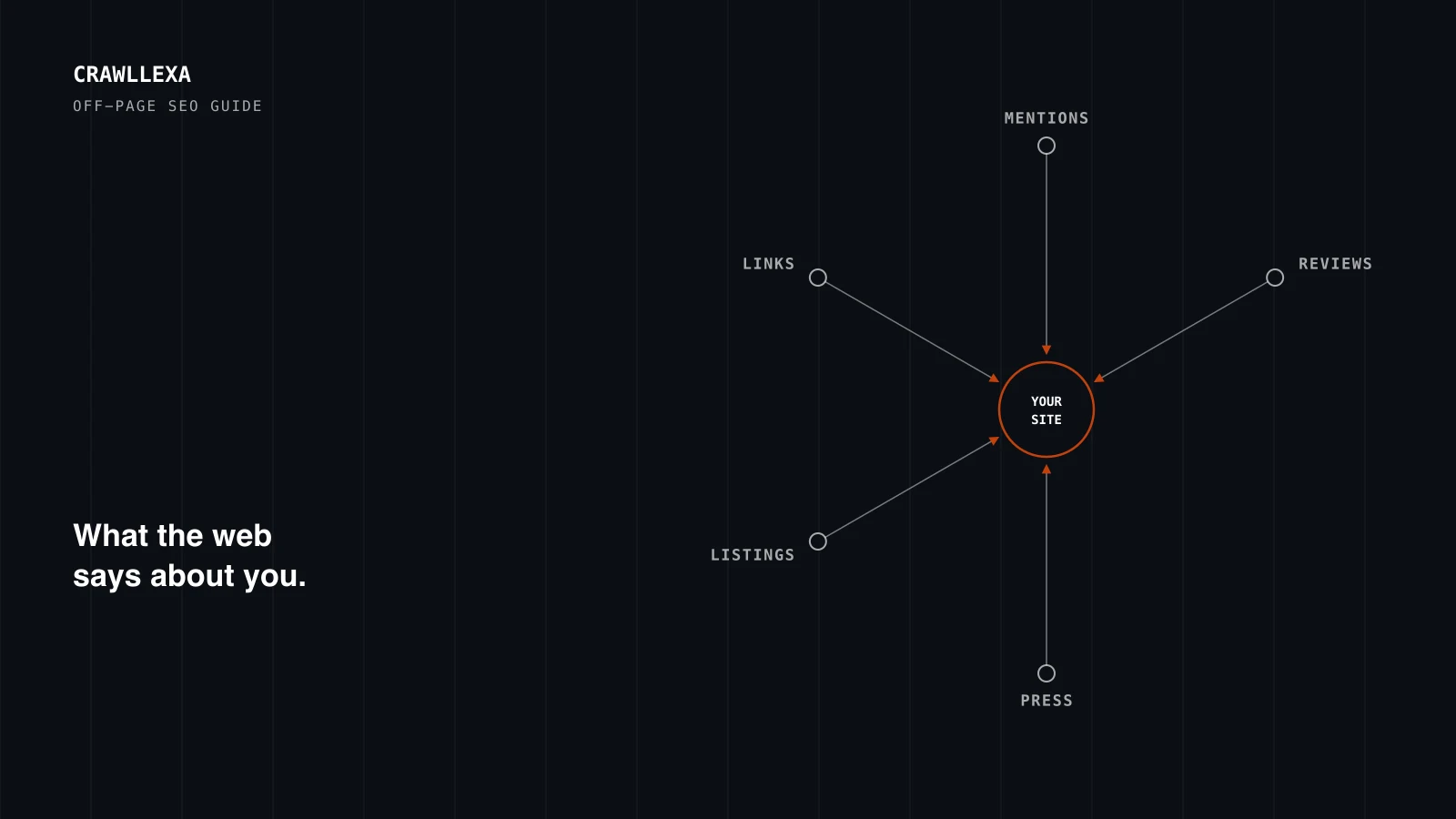
Off-page SEO is everything outside your own website that affects how search engines and AI systems judge it. That includes links from other sites, mentions of your brand, reviews, business listings, press coverage, and your presence on the platforms where people search and talk, from YouTube to industry forums. On-page SEO is what your pages say about you. Off-page SEO is what the rest of the web says.
It matters because a site can’t vouch for itself. Anyone can claim to be the best agency, the most reliable supplier or the leading expert. Search engines have always looked for evidence from elsewhere, and Google says so plainly: its systems judge quality partly by understanding “if other prominent websites link or refer to the content”. That second part, “refer to”, matters more every year, because AI answers are built from what the web says about a topic and the brands in it.
It’s also the part of SEO most full of shortcuts that don’t work. Bought links, link networks, mass guest posting and fake reviews have all been tried at scale, and Google has built systems specifically to ignore or penalize them. This guide covers what off-page signals actually do, what Google treats as spam, and the methods that earn links, mentions and reviews that last. It’s written for a beginner and for someone who has run link building programs for fifteen years, and every claim that matters links to its source.
How to read it. If you’re new to off-page SEO, read top to bottom. If you’re experienced, the sections on how Google now handles link spam, mentions and AI visibility, reviews policy and the disavow tool are the most likely to have changed since you last checked.
The short version
- Links still matter. Link analysis and PageRank remain one of Google’s core ranking systems. In Ahrefs’ research, two-thirds of pages had no backlinks at all, and 96.55% got no traffic from Google.
- Mentions matter too. Google looks at whether prominent sites link or refer to content. In a study of 75,000 brands, branded web mentions correlated with AI Overview visibility about three times more strongly than backlinks did.
- Quality and relevance beat volume. One editorial link from a respected site in your field is worth more than hundreds from sites that link to anyone.
- Manipulative links are neutralized. Since December 2022, Google’s SpamBrain system can detect both sites buying links and sites selling them. Bought links usually become worthless, and at worst bring a manual action.
- Paid placements are fine if they’re labeled. Sponsorships and advertising links should carry
rel="sponsored". - Reviews are an off-page signal. Google’s local rankings use prominence, which includes how many sites link to a business and how many reviews it has. Incentivized or selectively requested reviews break Google’s rules.
- Most sites never need to disavow links. Google ignores most spam on its own.
- Earn attention, then links follow. Original data, genuine expertise, relationships and being worth talking about are the durable strategies.
What off-page SEO covers
| Technical SEO | On-page SEO | Off-page SEO | |
|---|---|---|---|
| The question it answers | Can search engines access and process the site? | Does each page answer the search well? | Does the rest of the web vouch for the site? |
| Typical work | Crawling, rendering, indexing, speed | Intent, content, titles, headings, internal links | Links, mentions, reviews, listings, digital PR, community presence |
| Who controls it | You | You | Other people, which is why it’s earned rather than built |
The main off-page signals:
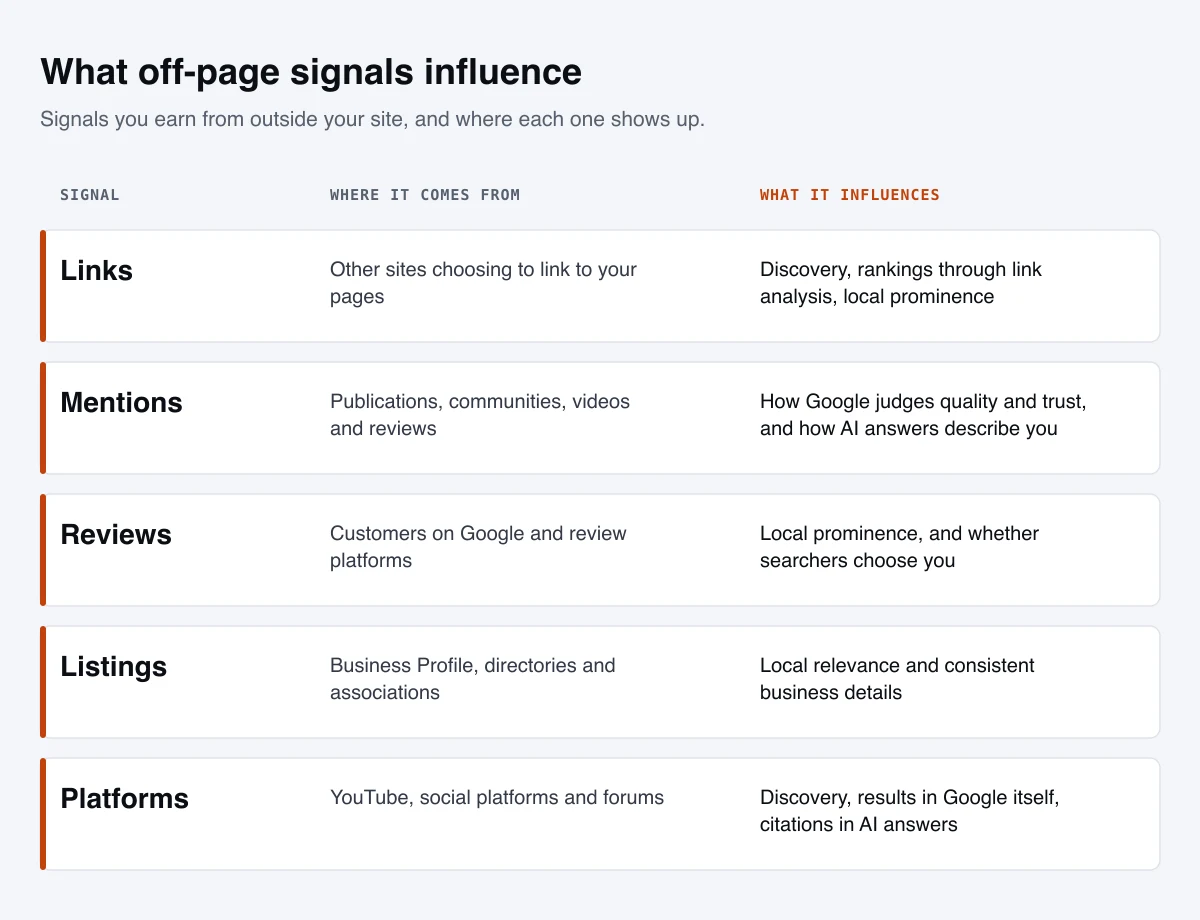
- Backlinks: links from other websites to yours.
- Brand mentions: references to your business, with or without a link.
- Reviews and ratings: on Google, marketplaces and industry review sites.
- Business listings and citations: consistent details about your business across directories and platforms.
- Press and publications: coverage, interviews, expert commentary and contributed articles.
- Platform presence: your content and reputation on YouTube, social platforms and communities, which increasingly appear in search results themselves.
How search engines use off-page signals
Links: discovery, relevance and endorsement
Links do three jobs at once. They’re how crawlers discover pages, since Google finds most new URLs by following links. Their anchor text and surrounding context help search engines understand what a page is about. And a link from one site to another works as a kind of endorsement: the idea behind PageRank, the algorithm Google launched with.
That idea is still at the core. Google’s guide to its ranking systems lists link analysis systems, including PageRank, among its core ranking systems. Google’s SEO Starter Guide adds the necessary perspective: PageRank is one of many signals, and there’s much more to Google Search than links.
Mentions and references
Google’s How Search Works site describes how its systems identify content that demonstrates expertise, authoritativeness and trustworthiness, and gives one factor as an example: whether other prominent websites link or refer to the content, which it calls generally a good sign that the information is trustworthy.
References without links have become far more visible with AI search. AI answers summarize what the web says about a topic, and name brands that are described often and consistently. In a 2025 study of 75,000 brands, Ahrefs found branded web mentions correlated with visibility in Google’s AI Overviews at 0.664, against 0.218 for backlinks. Its Q1 2026 AI search report found YouTube mentions correlated with AI brand visibility more strongly than any other metric it measured. These are correlations, not proof of cause, but they point the same way as Google’s own description.
Reviews and local prominence
For local searches, Google explains that results are based mainly on relevance, distance and prominence. Prominence means how well known a business is, and Google says it draws on information such as how many websites link to the business and how many reviews it has, adding that more reviews and positive ratings can help local ranking. That makes reviews and local links a direct off-page factor for any business with a physical presence or service area.
What the data says about links
Large studies consistently find the same pattern. Ahrefs’ search traffic study, covering about 14 billion pages, found 96.55% of pages get no traffic from Google at all. An earlier version of the same study, covering about a billion pages, found 66.31% had no backlinks at all, and that pages with more referring domains (unique linking websites) tend to get more search traffic. Correlation isn’t causation: pages that attract links also tend to be better pages. But the practical conclusion holds. For competitive searches, a page that nobody links to or mentions is rarely the one that ranks.
What makes a link valuable
Not all links are equal, and the difference between a valuable link and a useless one is usually obvious to a person looking at it.
| Factor | What to look for | Why it matters |
|---|---|---|
| Relevance | The linking site and page are about your field or your audience’s interests | A link in context says something about what you are; a random one says nothing |
| Editorial choice | Someone chose to link because your page helped their readers | Earned links are what link analysis is meant to reward; placed links are what spam systems look for |
| The linking site’s standards | It publishes real content for real readers and doesn’t link to anyone who pays | Sites used to pass links are exactly what SpamBrain detects |
| Placement | In the body of a relevant article, not a footer, sidebar or list of hundreds | Context carries meaning, and sitewide footer links are listed in Google’s link spam examples |
| Anchor text | Natural: your brand, the page title or a descriptive phrase | Keyword-stuffed anchors in articles and guest posts are a named link spam signal |
| New referring domains | A link from a site that hasn’t linked to you before | Many links from one site add less than links from many different respected sites |
| Real traffic | People actually click it | A link that sends visitors is valuable whatever else is true about it |
A note on metrics: Domain Rating, Domain Authority, Authority Score and similar numbers are estimates built by SEO tool companies. They can be useful for comparing sites quickly, but they aren’t Google’s data. Google’s guidance on third-party SEO tools states that no third-party tool has access to its internal ranking data. A high score on a site that sells links to anyone is worth less than a modest score on a respected specialist publication in your field.
What Google treats as link spam
Google’s link spam policy defines link spam as creating links to or from a site mainly to manipulate rankings. Its examples include:
- buying or selling links that pass ranking credit, whether for money, goods or services, including sending someone a free product in exchange for a post with a link
- excessive link exchanges, or partner pages that exist only for cross-linking
- automated programs or services that create links
- requiring a link as part of terms of service or a contract, without letting the other site qualify it
- advertorials or native advertising that pass ranking credit, and links with optimized anchor text in articles, guest posts or press releases distributed on other sites
- low-quality directory and bookmark site links
- links hidden in widgets, or spread across the footers and templates of many sites
- forum comments with optimized links in the post or signature
- low-value content created mainly to manipulate links and rankings
Google is also clear about what’s allowed: buying and selling links is a normal part of the web’s economy for advertising and sponsorship, as long as those links are qualified with rel="sponsored" or rel="nofollow".
How Google enforces it now
Two changes define modern link spam enforcement:
- Links are neutralized, not just penalized. In its December 2022 link spam update, Google said SpamBrain, its AI-based spam system, can now detect both sites buying links and sites used to pass outgoing links, and that credit from these unnatural links is lost. For most sites that bought links, the result isn’t a dramatic penalty; it’s money spent on links that quietly count for nothing.
- Link attributes are hints. Since 2019, Google has treated
nofollow,sponsoredandugcas hints rather than strict rules, so it can still learn from those links while respecting that they aren’t endorsements.
Manual actions still exist for deliberate, large-scale schemes, and appear in Search Console’s Manual actions report.
Guest posts, big-site placements and expired domains
Three related tactics deserve their own mention, because they’re still widely sold:
- Guest posting. Google doesn’t discourage articles that inform another site’s audience or raise awareness of your business. What it treats as a violation is guest posting whose main purpose is building links at scale: keyword-rich links, the same or similar articles spread across many sites, and writers who don’t know the subject. Write for audiences you genuinely want to reach, and let the link be incidental.
- Placing content on big sites to borrow their authority. Google’s site reputation policy covers third-party content published on an established site mainly to benefit from that site’s ranking signals. Pages found to violate it can face manual action outside the European Economic Area, and within the EEA are ranked separately from the host site, so they no longer benefit from its reputation.
- Buying expired domains. Repurposing an expired domain mainly to manipulate rankings with low-value content is expired domain abuse, for example turning a former charity’s domain into an affiliate site.
How to earn links that last
The durable approach is to be worth linking to and then make sure the right people know. Google’s own summary, from its 2017 guidance: focus on improving your site’s content, and links will follow. In practice, that needs some effort on the second half.
1. Create something worth citing
People link to sources. The most reliable way to earn links is to publish something others need to reference:
- Original data and research: surveys, benchmarks, analyses of your own anonymized data, or public data nobody has organized well.
- Tools and calculators that solve a recurring problem for your audience.
- Definitive explanations of topics your field gets wrong, backed by evidence.
- Visuals such as diagrams and charts that others want to reuse with credit.
- Templates and frameworks people can apply directly.
This series of guides is a good illustration. Across the pillar articles, we’ve linked to Google’s documentation, Ahrefs, Pew Research Center, Seer Interactive, Vercel and the HTTP Archive’s Web Almanac dozens of times. Every one of those links went to a source that published original data or first-hand documentation we couldn’t produce ourselves. That is how link-worthy content works.
2. Digital PR
Digital PR is getting coverage in publications your audience reads. It works best with something genuinely newsworthy: new data, a clear expert opinion on a current development, or a story only you can tell.
- Pitch data to journalists who cover your field, with the headline finding up front and the method available.
- Offer expert commentary. Journalist request services connect reporters with sources: HARO, relaunched under Featured.com in 2025, and similar services such as Qwoted. Answer only where you have real expertise, quickly and specifically.
- Build relationships with a few relevant writers instead of emailing hundreds of strangers.
- Don’t forget local and trade press, which are often more receptive and more relevant than national outlets.
Coverage without a link is still valuable. It’s a mention, it reaches your audience, and it often leads to links elsewhere.
3. Use relationships you already have
Most businesses have more link opportunities than they realize:
- suppliers, manufacturers and technology partners that list their clients or stockists
- clients who’d publish a case study or testimonial
- industry associations, chambers of commerce and professional bodies you belong to
- events you speak at or host, and universities or communities you work with
- local causes you genuinely support
If money or free products change hands for a link, such as an event sponsorship, the link should be marked rel="sponsored". That’s still valuable: it reaches an audience and associates your brand with the event.
4. Reclaim mentions and lost links
- Unlinked mentions. Search for your brand, products and people. Where a site mentions you without a link, a short, polite note asking them to add one often works, because it helps their readers.
- Broken inbound links. Check which of your old URLs still attract links but now return 404. Redirect each one to the most relevant live page. Search Console’s Links report and third-party link tools both show these.
- Incorrect links. Fix links that point to the wrong page or an old domain by asking the site owner.
5. Replace broken or outdated resources
Many sites maintain resource pages and guides with links that have died or gone stale. If you have a genuinely better, current resource on the same topic, letting the owner know helps them. This only works when your page really is the better resource.
6. Contribute expertise, not link placements
Writing for respected publications in your field, appearing on podcasts, speaking at events and answering questions in communities your buyers use all build reputation and often earn links. The test from Google’s guest-post guidance is useful: would you still write it if it contained no link to your site?
7. Be selective with directories and listings
A few listings matter: Google Business Profile, the main review platforms in your industry, relevant professional associations, and the major local directories for your area. Mass submissions to generic directories are listed as link spam in Google’s policy and add nothing.
Outreach that works
Whatever the tactic, the same rules apply. Contact people individually, show that you know their site, explain why your resource helps their readers, and don’t follow up repeatedly. Google’s 2017 guidance specifically notes that site owners dislike aggressive, repeated requests, and encourages them to report such cases as spam.
Brand mentions, entities and AI visibility
Search engines and AI systems increasingly understand businesses as entities: things with a name, a category, a location, people and relationships. Off-page work helps them describe yours correctly.
- Be consistent everywhere. Use the same business name, description, category, address and contact details on your site, Google Business Profile, LinkedIn, directories and review platforms. Contradictions make systems less confident about who you are.
- Connect your profiles. Link your official profiles from your site, and use Organization structured data with
sameAslinks to them. - Be present where your field talks. Industry publications, podcasts, YouTube and professional communities are where mentions and citations come from. Pew Research Center found Wikipedia, YouTube and Reddit were among the most frequently cited sources in Google’s AI summaries.
- Participate, don’t plant. Genuine answers from real people in communities earn trust. Planted posts and fake accounts are the opposite. Google’s 2026 guidance on AI search lists seeking inauthentic mentions among the tactics that don’t help, and its spam policies apply to AI answers too.
We cover how AI answers choose their sources, and how to track your brand’s visibility in them, in our guide to AEO and GEO.
Reviews and reputation
Reviews affect local rankings, click-through from search and maps, and whether people choose you once they find you. They’re also one of the most regulated parts of off-page work.
The rules
- Google Maps and Business Profile. Google’s policy on fake engagement prohibits offering incentives such as payment, discounts or free products in exchange for reviews, selectively asking only happy customers for reviews, and discouraging or preventing negative ones. It also rules out reviews from employees and others with a conflict of interest, pressuring customers to leave a review while on the premises, asking for specific content, and setting staff quotas for reviews. Reviews that break the policy are removed.
- Reviews on your own site. Google’s review snippet guidelines say not to include fake reviews or undisclosed incentivized reviews on your page or in your markup. A business’s reviews of itself collected on its own site aren’t eligible for review stars in search results.
- India. The Bureau of Indian Standards published IS 19000:2022, a standard for how platforms collect, moderate and publish online consumer reviews, based on principles of integrity, accuracy and transparency. It’s initially voluntary, but it sets clear expectations for any Indian business that publishes reviews.
A review process that works
- Ask every customer, not just the happy ones, at the moment the experience is complete: after delivery, after a project closes, after a visit.
- Make it easy, with a direct link to your review profile.
- Don’t offer anything in return, and don’t script what people should say.
- Reply to reviews, especially critical ones, calmly and specifically. Google’s local ranking guidance notes that replying shows you value feedback.
- Use what you learn. Recurring complaints are an operations problem, and fixing them does more for your reputation than any response.
Local off-page signals
For businesses that serve a location, off-page SEO is largely local SEO:
- A complete, verified Google Business Profile with accurate categories, hours, photos and services.
- Consistent citations: your business name, address and phone number matching exactly across the directories and platforms that matter in your area and industry.
- Local links: local press, chambers of commerce, community organizations, event listings, and suppliers or partners in your area.
- Reviews, managed as described above.
Google’s local ranking factors, relevance, distance and prominence, explain why these matter: you can’t change distance, but relevance comes from a complete profile and prominence comes largely from off-page signals. Our local SEO work is built around exactly this.
Social media, video and communities
Google’s Starter Guide recommends promoting your site through social media, community engagement, advertising and word of mouth, which it calls one of the most effective and lasting methods, because promotion leads to faster discovery by both people and search engines. It also warns that overdoing promotion can harm you: people tire of it, and search engines may see some practices as manipulation.
Google’s documentation doesn’t describe likes or shares as ranking signals. The value of social media for search is indirect but real: it puts your work in front of the people who write, link, review and search for you by name.
Social and video content is also becoming search content in its own right. In July 2026 Google added platform properties to Search Console, which show how a creator’s or business’s posts on YouTube, Instagram, TikTok and X perform in Google Search, Discover and Google News. And YouTube is one of the sources AI answers cite most, which is why a video presence now supports both search visibility and AI visibility. Our social media marketing work treats these platforms as search surfaces as well as social ones.
Measuring off-page SEO
Search Console’s Links report
The Links report shows your most linked pages, the sites that link to you most, and the most common link text. Keep its limits in mind: it’s a sample rather than every link, groups sites by root domain, can include links that have since been removed, and doesn’t say whether a link is nofollow. Use it to check that your most linked pages are the ones you’d expect, that the sites linking to you are ones you recognize, and that link text describes you accurately.
Third-party link indexes
Tools such as Ahrefs, Semrush, Majestic and Moz crawl the web independently and are better for competitor comparisons, spotting new and lost links, and finding sites that link to competitors but not to you. Their numbers vary between tools and are estimates. Bing Webmaster Tools also reports backlinks.
Brand and reputation signals
- Branded search demand: impressions and clicks for queries containing your brand name, in Search Console.
- Referral traffic from earned coverage and links, in analytics.
- Mentions in publications and communities, tracked with a monitoring tool or regular searches.
- AI visibility: whether you’re named and cited in AI answers for your key queries.
- Reviews: count, average rating, how often new ones arrive, and how quickly you respond.
KPIs worth reporting
| Area | What to track | Where |
|---|---|---|
| Links | New and lost referring domains; links to key pages | Search Console, third-party link tools |
| Link quality | Share of new links from relevant, editorial sources | Manual review of new links |
| Mentions | Coverage and brand mentions, with and without links | Monitoring tool, regular searches |
| Brand demand | Branded search impressions and clicks | Search Console |
| Reviews | Volume, rating, recency, response rate | Google Business Profile, review platforms |
| Outcomes | Referral traffic and leads from earned placements; rankings for competitive queries | Analytics, CRM, Search Console |
Toxic links, disavow and negative SEO
Every site that’s been online for a while collects some spammy links it never asked for. Google’s position on these is reassuring. Its disavow documentation says that in most cases Google can work out which links to trust, and that most sites won’t need the disavow tool. It recommends disavowing only when both of these are true:
- you have a considerable number of spammy, artificial or low-quality links pointing to your site, and
- they have caused a manual action, or likely will.
Google also warns that the tool is advanced, and that using it incorrectly can harm your performance. So:
- Don’t disavow on the basis of third-party “toxic link” scores. They’re a tool’s guess, and disavowing good links removes their value.
- If you or a previous agency bought links, try to have them removed first, then disavow what you can’t remove, especially if you’ve received a manual action.
- Worried about negative SEO? Google says it works hard to make sure actions on third-party sites don’t negatively affect a website. Keep an eye on the Links report and the Manual actions report, and act only if a real problem appears.
Off-page SEO myths
| Myth | What’s actually true |
|---|---|
| Domain Authority or Domain Rating is a Google metric | They’re third-party estimates. Google says no third-party tool has its internal data |
| More links always means better rankings | Relevance and quality matter more, and manipulative links are neutralized |
| Nofollow links are worthless | Google treats them as hints, and they still bring visitors and reputation |
| Social shares directly raise rankings | Google hasn’t said so. The value is indirect: reach, mentions, links and brand searches |
| You should disavow toxic links regularly | Google says most sites never need to disavow |
| Guest posting is banned | Guest articles for a real audience are fine; guest posting at scale for links isn’t |
| Buying links from high-authority sites is safe if it looks natural | It violates Google’s policy, and SpamBrain detects sites that sell links |
| Publishing on a big site lets you borrow its authority | That’s what Google’s site reputation policy targets |
| An expired domain with backlinks is a shortcut | Repurposing it mainly to manipulate rankings is expired domain abuse |
| AI search has made links irrelevant | Link analysis is still a core ranking system; mentions have become more important alongside links, not instead of them |
A 90-day off-page plan
Weeks 1 to 2: audit
- Review the Links report and a third-party link index: which pages attract links, from whom, and with what link text.
- Compare your referring domains with the pages that outrank you for your main queries.
- Search for your brand to find unlinked mentions, inaccurate descriptions and outdated listings.
- Review your Google Business Profile and review profiles: completeness, rating, recency and responses.
- Check whether any past link buying needs cleaning up.
Weeks 3 to 6: foundations
- Redirect old URLs that still have links but return 404.
- Make business details consistent across your main listings and profiles.
- Set up a review request process that asks every customer.
- Ask for links on unlinked mentions and incorrect links.
- List every relationship that could reasonably link to you: suppliers, partners, clients, associations, events.
Weeks 7 to 12: earn attention
- Publish one asset designed to be cited, such as original data, a benchmark or a useful tool, and pitch it to relevant writers and communities.
- Start regular expert commentary through journalist request services and trade press.
- Approach your relationship list, one by one.
- Take part in one or two communities your buyers use, as yourself.
Ongoing
- Report monthly on new referring domains, mentions, reviews and branded search, and quarterly on rankings for competitive queries.
Where off-page SEO fits
Off-page SEO depends on the other two layers. Technical SEO makes sure the pages people link to can be crawled and indexed, and on-page SEO makes sure they deserve the links they get. The link-worthy assets that drive off-page results usually come from content strategy and content marketing, and much of the reputation work overlaps with local SEO and social media marketing.
The common thread is that off-page SEO rewards businesses that are genuinely worth talking about. The job is to do work people want to reference, make sure the right people see it, and make it easy for search engines to recognize that reputation.