 Crawllexa
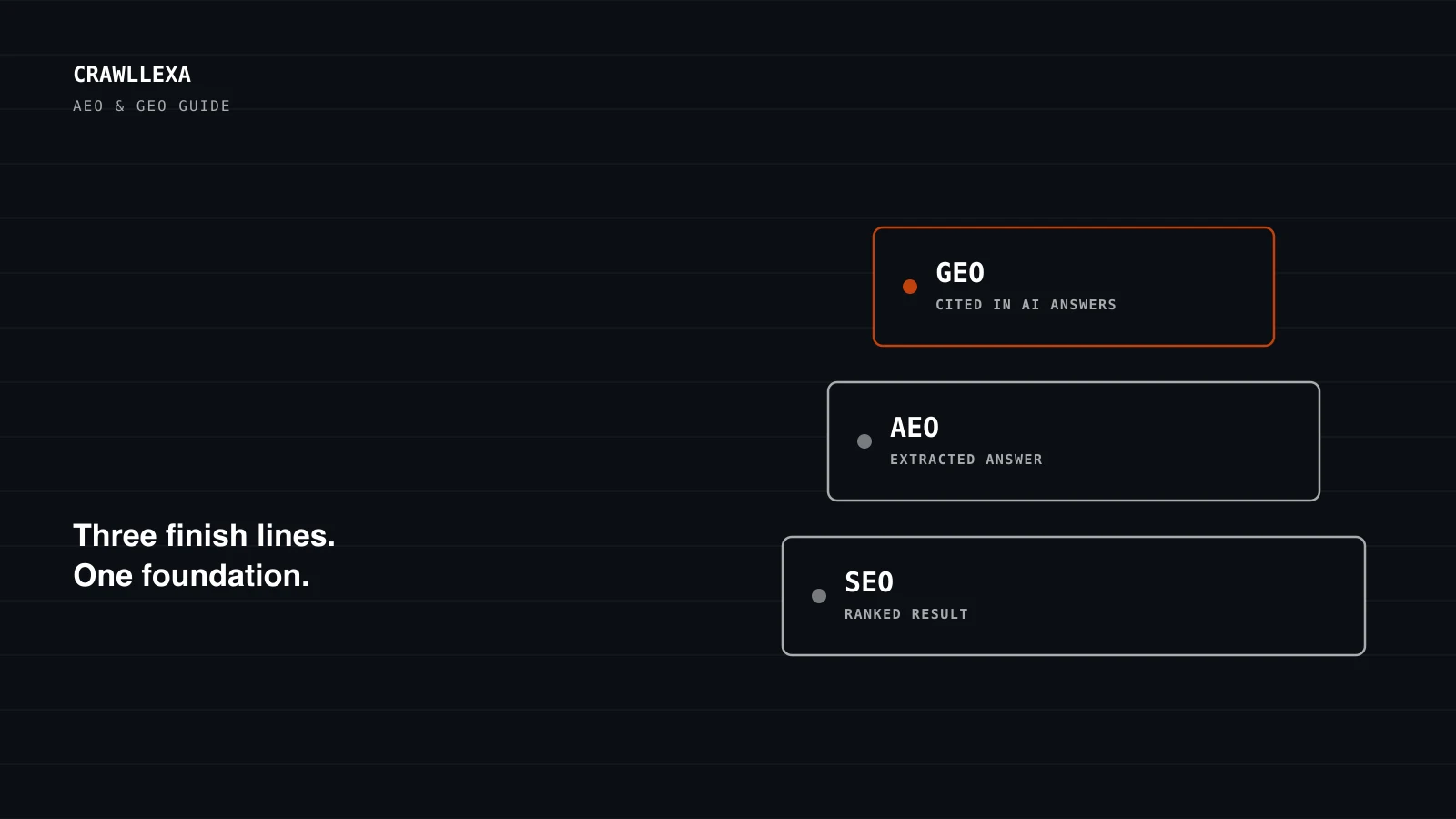
AEO (answer engine optimization) and GEO (generative engine optimization) are the work of getting your content used as the source when a machine answers a question: pulled into a featured snippet, cited in a Google AI Overview or AI Mode response, or named and linked in an answer from ChatGPT, Perplexity, Microsoft Copilot, Gemini or Claude. The goal shifts from winning a click on a list of results to becoming part of the answer itself.
Neither one replaces SEO. Google’s own guidance, published in May 2026, says that optimizing for its generative AI features “is optimizing for the search experience, and thus still SEO.” That’s broadly right, and also incomplete. There are now more engines and crawlers you need to be accessible to, the unit that competes has shrunk from a page to a passage (and, for recommendations, to your brand’s reputation), and measuring success works differently. This guide covers all of it, from first definitions to crawler-level decisions, and links to the primary source behind every claim that matters.
How to read it. If AEO and GEO are new to you, read it top to bottom. If you’ve worked in SEO for years, the sections most likely to be new are how AI answers get built, the crawler access table, where Google and Microsoft disagree, and measurement.
The short version
- AEO targets the extracted answer: featured snippets, voice answers, AI Overviews. GEO targets citations and brand mentions inside answers an AI writes from several sources. Most of the underlying work is shared, and all of it sits on top of SEO.
- Google’s AI features expand a question into many related searches, a process called query fan-out, and retrieve pages for each one from the normal search index. Ranking for the main query no longer guarantees the citation: in Ahrefs’ 2026 data, only about 38% of pages cited in AI Overviews ranked in the top 10 for the original query.
- Each AI assistant draws on a different index and crawler. Blocking the wrong bot, or letting your CDN block it for you, removes you from that assistant’s answers entirely.
- The content that gets cited is specific, verifiable and original. In controlled experiments, adding citations, quotations and statistics lifted a source’s visibility in generated answers by 30 to 40%. Keyword stuffing did close to nothing.
- Brand mentions across the web correlate with AI visibility more strongly than backlinks do. They have to be earned: Google’s spam policies apply to AI answers too.
- You can ignore llms.txt for Google, artificial “chunking”, rewriting everything for AI, and FAQ markup for its own sake.
- Measure with Search Console’s generative AI performance report, Bing Webmaster Tools’ AI Performance report, AI referral traffic in analytics, and a fixed set of prompts checked on a schedule.
What AEO and GEO actually mean
Answer engine optimization (AEO)
Answer engine optimization is structuring content so a search system can lift a direct answer out of it and show that answer on its own. The term is older than generative AI. It grew up around featured snippets, “People also ask” boxes, knowledge panels and voice assistants, where a single source supplies a single answer and the person often never clicks through.
In classic AEO, one page wins one answer slot, and the levers are mostly on-page: a heading that matches the question, a concise answer directly beneath it, and supporting detail after that. The term is now used more loosely, and many people put Google’s AI Overviews under AEO too, since they also sit at the top of the results page and answer the query directly.
Generative engine optimization (GEO)
Generative engine optimization is improving the chance that a large language model (LLM) includes, cites or recommends you when it writes an answer from several sources. The term was formalized in a 2023 research paper by researchers at Princeton University and IIT Delhi, later published at the KDD 2024 conference. The paper described “generative engines” as systems that retrieve sources and then use a language model to write a response citing them, and it measured which content changes made a source more visible inside those responses. We cover what it found further down.
GEO applies wherever an answer is synthesized: Google AI Overviews and AI Mode, ChatGPT search, Perplexity, Copilot, Gemini and Claude. A synthesized answer has no single winning slot. Several sources contribute, some are visibly cited, some shape the answer without credit, and a brand can be named without any link at all.
The difference in one line
AEO is about being the answer that gets extracted. GEO is about being one of the sources an answer is built from, or the brand the answer recommends.
In practice they overlap so heavily that most practitioners, us included, treat them as one discipline with two emphases.
Other names for the same work
You’ll run into several other terms. It helps to know which ones describe the same thing:
- AIO (AI optimization), LLMO (large language model optimization), AI SEO and generative search optimization are broadly synonyms for GEO.
- SXO (search experience optimization) is a different idea. It covers what happens after the click: speed, usability, and whether the page satisfies the visitor.
- Search everywhere optimization is an umbrella term for visibility across Google, AI assistants, YouTube, marketplaces and social search.
One trap: some agencies use “GEO” to mean geographic or local SEO. If someone offers you GEO services, ask which one they mean.
What Google and Microsoft say
Google’s position is explicit. Its guide to optimizing for generative AI features, added in May 2026, says AI Overviews and AI Mode are rooted in its core ranking and quality systems, treats AEO and GEO as SEO from Google’s point of view, and lists popular “AEO/GEO” tactics that Google Search ignores. A separate page on evaluating third-party SEO advice, added in June 2026, names AEO and GEO tools specifically and recommends checking their claims against official documentation.
Microsoft is more prescriptive. Its October 2025 guidance on inclusion in AI answers across Bing and Copilot describes its systems breaking pages into smaller pieces and judging each piece on clarity and how directly it answers the question. It recommends clear headings, lists, tables, Q&A formats and schema markup. In February 2026, Microsoft added an AI Performance report to Bing Webmaster Tools that shows how often a site is cited in Copilot and Bing’s AI answers.
Our view: treat AEO and GEO as SEO with a different finish line. Three things genuinely change.
- The unit that competes. SEO ranks pages. Answer engines select passages, and for recommendation-style questions they also weigh what the wider web says about your brand.
- The number of gatekeepers. You need to be crawlable and indexable by several systems with different crawlers, rules and indexes, not only Googlebot.
- How you measure. Rankings and clicks don’t capture being cited in an answer nobody clicks. First-party reports for this now exist, but they’re young.
SEO vs AEO vs GEO at a glance
| SEO | AEO | GEO | |
|---|---|---|---|
| What you’re trying to win | A ranked result and the click | The extracted answer | A citation or brand mention inside an AI-written answer |
| Where it appears | Organic search results | Featured snippets, “People also ask”, voice answers, AI Overviews | AI Overviews, AI Mode, ChatGPT, Perplexity, Copilot, Gemini, Claude |
| The unit that competes | The page | The passage | The passage and the brand |
| Main levers | Relevance, technical health, links | Question-matched headings, direct answers, clear formatting | Everything in SEO and AEO, plus specific sourced facts, brand mentions and access for AI crawlers |
| Main measurement | Rankings, clicks, CTR | Answer ownership, impressions | AI impressions and citations, AI referral traffic, prompt sampling |
Why this matters now
The scale of AI answers
Google reports that AI Overviews reach 2.5 billion monthly users, and that AI Mode passed one billion monthly users within a year of launch, with queries more than doubling every quarter. In May 2026 Google also made it possible to ask follow-up questions directly from an AI Overview, which keeps more of a research session inside Google’s answer. Outside Google, AI assistants have become a normal starting point for research, especially for comparisons and recommendations.
What AI answers do to clicks
The evidence that AI answers reduce clicks on classic results is consistent across very different methods.
- Pew Research Center (July 2025) analyzed the real browsing of 900 US adults in March 2025. When a Google search showed an AI summary, people clicked a traditional result in 8% of visits, against 15% when no summary appeared. They clicked a link inside the summary itself in just 1% of visits.
- Ahrefs (February 2026) compared Search Console data for 300,000 keywords between December 2023 and December 2025, and found AI Overviews reduced clicks to the position-one result by 58%, up from 34.5% in its April 2025 study.
- Seer Interactive (April 2026) tracked 53 brands and 5.47 million queries through February 2026. Organic click-through rates were lower when an AI Overview appeared, but brands cited inside the AI Overview earned about 120% more organic clicks per impression than brands that weren’t. Seer notes that one large account weighs heavily on its not-cited figure.
What that means in practice
Two things are true at once. Informational queries send fewer clicks than they used to, and the clicks that remain go disproportionately to the sources an answer cites. Being cited is becoming the price of being visited.
There’s also value without the click. When an assistant names your brand as an option, the person may search for you by name later, visit directly, or ask the assistant a follow-up about you. That influence doesn’t show up in last-click reports, which is why measurement gets its own section below.
Google says that clicks from results pages with AI Overviews are higher quality, meaning people spend more time on the site. That’s Google’s claim about its own product, and it’s worth checking against your own analytics rather than taking on trust.
Keep a sense of proportion, too. For most sites, referral traffic from AI assistants is still small next to organic search. The case for AEO and GEO isn’t that SEO has stopped working. It’s that the same questions are increasingly answered before anyone clicks, and you want to be part of that answer.
How AI answers get built
Understanding the mechanism is what separates useful AEO and GEO work from a checklist. Here’s what happens between a question and a cited answer.
Two routes into an answer: training and retrieval
A language model can mention your business by two different routes, and each one responds to different work.
From training data. During training, a model learns from a very large snapshot of text. If your brand was widely and consistently described across the web before that snapshot, the model may “know” about you without searching anything. This changes slowly, there’s no way to submit to it, and your main control is whether your own site may be used for training.
From retrieval at question time. Most AI search products look things up when asked: they query an index, read the pages that come back, and write an answer grounded in them, usually with citations. This is called retrieval-augmented generation (RAG), or grounding. Google describes AI Overviews and AI Mode as working this way, using its core ranking systems to fetch pages from the Search index. Retrieval responds to ordinary SEO work, and it’s where AEO and GEO have the most leverage.
Most AI search answers combine the two. The model’s general knowledge frames the answer, and retrieved pages supply the specifics and the citations.
From question to citation, step by step
- The question is interpreted. Prompts to AI tools are usually longer and more conversational than keyword searches, and can carry context from earlier in the conversation.
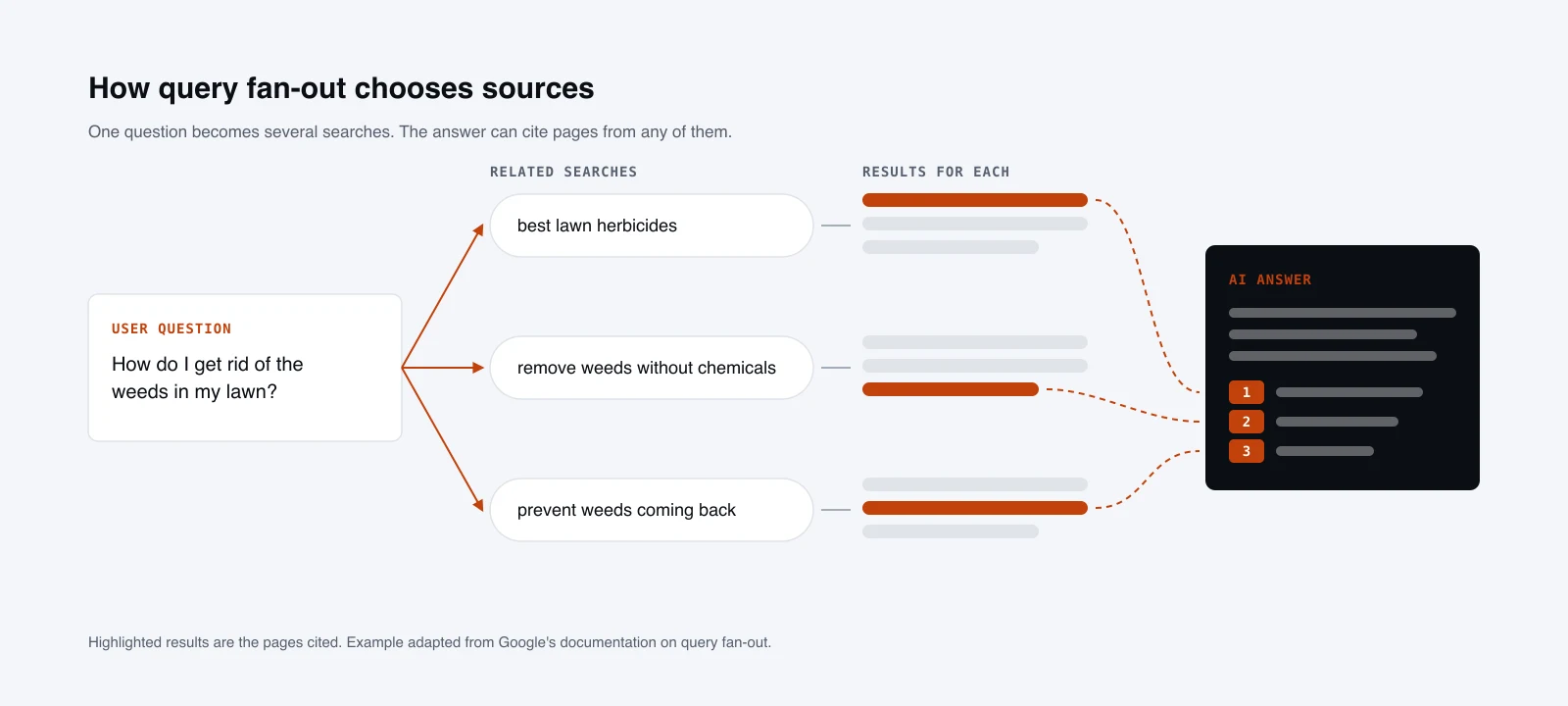
- The query fans out. The system runs several related searches to cover the sub-topics. Google’s own example: a question about fixing a lawn full of weeds might fan out into searches about the best lawn herbicides, removing weeds without chemicals, and preventing weeds. This isn’t unique to Google. OpenAI’s help center explains that ChatGPT search rewrites a question into one or more targeted queries for its search partners, then may send more specific follow-up queries after reviewing the first results.
- Pages are retrieved from that engine’s index for each of those searches.
- Passages are selected. The system reads the candidate pages and picks the parts that answer each piece of the question most directly and reliably.
- The answer is written from those passages.
- Sources are attributed. Some sources appear as visible links or citations. Others shape the answer without being credited.
A failure at any step takes you out of consideration. A page blocked at step 3 can’t be cited however good it is, and a page that’s retrieved but vague rarely survives step 4.
Why ranking first no longer guarantees the citation
Fan-out changes what you’re competing for. When Ahrefs studied AI Overview citations in July 2025, 76% of cited pages ranked in the top 10 for the query. Its March 2026 follow-up, covering 863,000 keywords and four million cited URLs, found that only 38% did. About 31% ranked between positions 11 and 100, and 31% didn’t rank in the top 100 for the original query at all.
Part of that gap comes from Ahrefs detecting citations more completely in the second study, so the two numbers aren’t perfectly comparable. But Ahrefs also points to Google moving AI Overviews to Gemini 3 in January 2026, and to sources increasingly coming from fan-out searches rather than the original results page. The practical lesson holds either way: you’re competing for the sub-questions around a query, not only for the query itself.
That doesn’t mean rankings stopped mattering. Retrieval still runs on search indexes and ranking systems, and a page that ranks for nothing gets retrieved for nothing. It means the set of searches you need to be findable for is wider than your main keyword.
It also doesn’t mean you should publish a page for every sub-question. Google warns that creating separate content for every fan-out variation mainly to influence AI responses violates its scaled content abuse policy. Cover the sub-questions inside pages that deserve to exist, and link related pages to each other.
Which index feeds which assistant
Each assistant retrieves from a different place. If you’re missing from an index, you’re missing from every product built on it.
| Surface | Where live results come from | Crawler that needs access |
|---|---|---|
| Google AI Overviews and AI Mode | Google Search index | Googlebot |
| Gemini app | Google Search index, through grounding | Googlebot, without blocking the Google-Extended token |
| ChatGPT search | Partner search providers (OpenAI lists Microsoft among them) plus OpenAI’s own crawler | OAI-SearchBot |
| Microsoft Copilot and Bing AI answers | Bing index | Bingbot |
| Perplexity | Perplexity’s own index | PerplexityBot |
| Claude web search | Anthropic’s search crawler, plus pages fetched when a user asks | Claude-SearchBot |
Sources: Google, OpenAI, Microsoft, Perplexity, Anthropic.
Two implications stand out. First, Bing now matters well beyond its own search share: it powers Copilot, and Microsoft is among the search partners ChatGPT search uses. Second, Google’s AI features and the Gemini app are controlled differently. AI Overviews and AI Mode follow Googlebot and your Search Console settings, while grounding in the Gemini app also depends on the Google-Extended token.
What controlled experiments found
The GEO paper is still the most useful controlled evidence on what makes a source more visible inside generated answers. The researchers built a benchmark of 10,000 queries, took the top five Google results for each, rewrote one source at a time using nine different methods, and measured how much of the generated answer drew on that source.
- Adding evidence worked best. Citing credible sources, adding relevant quotations and adding statistics each improved visibility by roughly 30 to 40% on the paper’s main measure, a word count weighted by how early in the answer the source appears.
- Keyword stuffing did little or nothing. Adding more of the query’s keywords, the old-school SEO reflex, offered little to no improvement.
- Lower-ranked pages gained the most. Adding citations raised visibility by 115% for sources ranked fifth in Google, while for top-ranked sources the same change lowered visibility by about 30% on average. Evidence can partly close a ranking gap.
- What works depends on the topic. Statistics helped most for law and government, debate and opinion queries. Quotations helped most for people and society, explanation and history. Citing sources helped most for factual statements and law and government.
- Combining methods beat any single method. Pairing more fluent writing with added statistics outperformed the best single strategy by more than 5.5%.
Read these results as a direction, not a formula. The experiments used a 2023-era model (GPT-3.5 Turbo) as the answer engine, with a smaller check against Perplexity, and the rewrites themselves were produced by a language model. Production systems in 2026 are different and change often. The durable finding lines up with Microsoft’s advice and with what Google calls non-commodity content: specific, sourced, evidence-rich writing is more useful to an answer engine than vague writing, and repeating keywords doesn’t help.
The AEO and GEO playbook
The steps below run in order of dependency. A problem early in the list blocks everything after it, so don’t start with content rewrites if crawlers can’t reach the site.
1. Make sure every engine can reach you
Google. To appear in AI Overviews or AI Mode, a page must be indexed and eligible to show in Google Search with a snippet. There are no extra technical requirements. Since mid-2026 there’s one new condition: the site must be included in Search generative AI features in Search Console. That setting lets a site owner opt an entire property out of AI Overviews, AI Mode and generative AI features in Discover, and Google says opting out isn’t used as a ranking signal anywhere else in Search. If you want AI visibility, check that nobody has switched it off.
Snippet controls. Google applies nosnippet, data-nosnippet, max-snippet and noindex to its AI features as well as to regular results. A max-snippet:0 in a template, or a stray data-nosnippet around key content, quietly limits what AI features can use. These are also the right tools if you deliberately want to hold specific content back.
AI crawlers. Each AI company runs different bots for different jobs, and blocking one doesn’t block the others. The distinction that matters is search, training, or fetching on a user’s behalf.
| Token | Company | What it’s for | If you block it |
|---|---|---|---|
| OAI-SearchBot | OpenAI | Crawling for ChatGPT search | Your pages aren’t shown in ChatGPT search answers, though they can still appear as navigational links |
| GPTBot | OpenAI | Crawling content that may be used to train models | Your content isn’t used for training; ChatGPT search is unaffected |
| ChatGPT-User | OpenAI | Fetching a page when a user’s request needs it | Blocking may not work: robots.txt may not apply to user-initiated requests |
| PerplexityBot | Perplexity | Crawling to surface and link sites in Perplexity; not used for training | You drop out of Perplexity’s results |
| Perplexity-User | Perplexity | Fetching pages to answer a user’s question | Blocking may not work: this fetcher generally ignores robots.txt |
| Claude-SearchBot | Anthropic | Indexing content for Claude’s search results | Lower visibility in Claude’s search answers |
| ClaudeBot | Anthropic | Collecting content that may be used for training | Your future content is excluded from training |
| Claude-User | Anthropic | Fetching pages when a Claude user asks | Claude can’t retrieve your pages on request |
| Google-Extended | A robots.txt token, not a separate crawler, covering Gemini training and grounding in the Gemini app | No effect on Google Search, AI Overviews or AI Mode |
Sources: OpenAI, Perplexity, Anthropic, Google.
For most businesses that want AI visibility, the sensible default is to allow the search crawlers. Training is a separate business decision. Blocking GPTBot or ClaudeBot doesn’t remove you from ChatGPT or Claude search, but it does mean future models learn about you only from what other people publish.
If you do decide to opt out of training while staying visible in AI search, the policy looks like this:
# Allow AI search crawlers
User-agent: OAI-SearchBot
Allow: /

User-agent: PerplexityBot
Allow: /

User-agent: Claude-SearchBot
Allow: /

# Opt out of model training
User-agent: GPTBot
Disallow: /

User-agent: ClaudeBot
Disallow: /

# Trade-off: this also removes your pages from grounding in the Gemini app
User-agent: Google-Extended
Disallow: /
Many businesses that want maximum reach simply allow everything. Either way, make it a decision rather than an accident.
Infrastructure. robots.txt is only half the picture. Firewalls, bot-protection services and CDNs can block AI crawlers before robots.txt is ever read. Since July 1, 2025, Cloudflare asks every new domain whether to allow AI crawlers at all. Google’s own documentation lists allowing crawling in your CDN and hosting setup, not only in robots.txt, among the basics for its AI features. Check your server or CDN logs for these user agents, and for 403 or 429 responses to them, rather than assuming access.
Rendering. Put the content that matters in the HTML. Google renders JavaScript, but a December 2024 study by Vercel and MERJ found that none of the major AI crawlers it measured, including OpenAI’s and Anthropic’s, executed JavaScript. They fetch script files but can’t read content rendered in the browser. Microsoft also advises against keeping core information only in images or PDFs, or hidden in tabs and expandable menus its systems may not render. Server-rendered or static HTML avoids all of this, and it’s standard technical SEO.
Bing. Verify your site in Bing Webmaster Tools, submit your sitemap, and use IndexNow to tell Bing when pages change. Microsoft recommends IndexNow specifically for keeping content fresh in its AI answers.
2. Publish content worth citing
Access gets you considered. Content decides whether you’re used. Google’s guide says that content people find unique, compelling and useful is likely to influence your presence in its AI features, in the long run, more than any other suggestion it makes.
Know commodity from non-commodity content. Google draws the line with an example. A generic list of tips for first-time homebuyers is commodity content: common knowledge anyone could write. A first-hand account of why a buyer waived the standard inspection, and what checking the sewer line revealed, is non-commodity: it offers experience that isn’t available anywhere else. Answer engines already have the commodity version, because they can generate it. They cite what they can’t produce themselves. This is the first “E” in what Google calls E-E-A-T: experience, alongside expertise, authoritativeness and trustworthiness. (We cover Google’s wider helpful-content guidance in our post on Google’s guidelines for building an online presence.)
Most businesses already have non-commodity material they don’t publish:
- Numbers from your own work: timelines, costs, results, before-and-after data.
- Decisions and trade-offs you’ve watched play out, including what didn’t work.
- Original research: a survey, an analysis of your own data, a test you ran.
- Specifics: named tools and versions, prices, regional details, dates.
Lead with the answer. When a section answers a question, resolve it in the first sentence or two, then support it. That serves skimming readers, and it gives an answer engine a passage it can use without reconstructing the answer from a long wind-up. Compare two openings for a section on canonical tags:
Before: “When it comes to technical SEO, there are many elements to think about, and canonical tags are one of the most misunderstood. In this section, we’ll explore what they are and why they matter.”
After: “A canonical tag (rel="canonical") tells search engines which URL is the main version of a page when several URLs show the same or very similar content. Google treats it as a strong signal rather than a command, and weighs it alongside other signals such as redirects and sitemaps.”
The first version says nothing a reader or an answer engine can use. The second can be quoted as it stands.
Make each section stand on its own. A passage lifted into an answer loses the paragraphs around it. Name the subject instead of leaning on “it” or “this approach”. Define terms where you use them. Keep the conditions that make a claim true, such as “for sites under 1,000 pages” or “as of September 2026”, in the same sentence as the claim. Microsoft’s guidance asks for exactly this kind of phrasing, which still makes sense when pulled out of context.
That isn’t the same as “chunking”. Google says there’s no need to break content into tiny pieces for AI, because its systems can find the relevant part of a long page. Write normal sections under clear headings. Just don’t make them depend on each other to make sense.
Be specific and verifiable. Replace qualitative claims with numbers, named sources and dates wherever you honestly can. In the GEO experiments, statistics, quotations and citations were the most effective changes, and Microsoft’s guidance says to anchor claims in measurable facts. Link to the primary source, not to someone else’s summary of it. This is also just good writing.
Cover the questions around the question. Map the sub-questions a real buyer asks around your topic: what it is, how it works, what it costs, how it compares, who it’s for, and what goes wrong. Answer them within the page, or across a small cluster of pages that link to each other. That’s how you become findable for fan-out searches without creating thin pages, or pages that compete with each other (see our guide to keyword cannibalization).
Match the format to the question. Comparisons belong in tables. Processes belong in numbered steps. Definitions start with a one-sentence definition. Microsoft notes that lists and comparison tables work especially well for how-to and comparison queries. Formatting should follow the question, not be applied everywhere by default.
Keep facts current and dates honest. Update a page when the facts in it change, and change its modified date when you do. Bumping the date on an unchanged page doesn’t make it fresher; it only makes the date less trustworthy. Microsoft names freshness as one of the qualities its AI answers favor.
Support the text with images and video where they help. Google’s AI features can show images and video alongside an answer, which gives you more ways in than a text link. Video is heavily used as a source: YouTube is among the sites Google’s AI summaries cite most often according to Pew, and it accounted for 5.6% of all AI Overview citations in Ahrefs’ 2026 study.
Most of this is on-page SEO done with more discipline, and choosing which questions deserve a page at all is content strategy.
3. Build the entity: make your brand easy to describe correctly
When someone asks an assistant to recommend a provider, compare brands or explain what a company does, the answer depends less on any single page and more on what the web as a whole says about you.
What the data shows. In a study of 75,000 brands, Ahrefs found that branded web mentions correlated more strongly with brand visibility in AI Overviews (0.664) than backlinks did (0.218). Branded anchor text (0.527) and branded search volume (0.392) came next. That’s a correlation, not proof of cause, and brands that get talked about more tend to be bigger in every other way too. But it points the same way as the mechanics: a brand that’s described often and consistently is easier for a system to describe with confidence.
Be consistent everywhere. Use the same name, description, category, services, location and contact details on your site, Google Business Profile, LinkedIn, directories and review platforms. Contradictions give a model reasons to hedge, or to get you wrong.
Make your own site unambiguous. A clear About page, real author pages that show relevant experience, visible contact details, and Organization or LocalBusiness structured data with sameAs links to your official profiles all help a system connect your site to the entity it already knows about.
Earn mentions; don’t manufacture them. The mentions that count come from being worth mentioning: original data that others cite, expert commentary, genuine reviews, talks, podcasts, and useful participation in the communities your buyers use. Google lists seeking inauthentic mentions among the tactics to ignore, and in May 2026 it clarified that its spam policies apply to generative AI responses too. Planted forum posts and paid “best of” lists are a reputational risk as well as a policy one.
For a local business, much of this work is local SEO: your Business Profile, citations and reviews.
4. Use structured data for what it actually does
Structured data won’t get you into AI answers on its own. Google says there’s no special schema needed for its AI features and cautions against overfocusing on it. Its real value is making facts unambiguous and keeping you eligible for rich results.
Two 2026 changes are worth knowing:
- FAQ rich results are gone. Google stopped showing them on May 7, 2026 and removed the documentation in June, according to its documentation changelog. FAQPage is still valid schema.org markup and does no harm on a genuine FAQ, but it no longer earns a special result in Google. Don’t create FAQ blocks just for the markup.
- Other engines still value it. Microsoft recommends schema such as FAQ, HowTo, Product and Review to make meaning explicit to its AI systems.
Prioritize the types that describe real facts about your business and content: Organization or LocalBusiness, Article with a named author, Product and Offer, Review, and BreadcrumbList. Whatever you mark up must match what’s visible on the page. Google lists that among the basics for its AI features.
5. Local and ecommerce: feed the structured sources directly
AI answers increasingly include product details and local business information drawn from structured sources, not only from web pages. Google’s guide points to Merchant Center product feeds and Google Business Profile as ways to appear in both AI responses and regular results. Keep prices, stock, opening hours, services and service areas current in both, because stale data in a feed becomes a wrong answer. We cover this in more depth under ecommerce SEO and local SEO.
6. Prepare for AI agents
The next shift is AI agents that act on a person’s behalf: comparing products, filling in forms, making bookings. Google notes that browser agents may read a site through screenshots, the page’s DOM and its accessibility tree. The practical preparation is ordinary good engineering: buttons and form fields with clear labels, key actions that work without fragile scripts, and prices and availability in plain HTML. Google also points to emerging standards such as the Universal Commerce Protocol. For most businesses this is something to watch rather than a project to start today.
What to ignore
Many AEO and GEO checklists are padded with tactics that don’t work or no longer matter. Google’s guide addresses several directly.
- llms.txt and other “AI files”. llms.txt is a proposed text file meant to summarize a site for language models. Google Search doesn’t use it, and says keeping one will neither help nor hurt your visibility. It can be useful for developer documentation that coding tools read, but it isn’t a lever for AI search visibility.
- “Chunking” content into fragments. There’s no requirement to break content into small pieces. Write well-structured sections for readers.
- Rewriting everything for AI. AI systems understand synonyms and meaning, so you don’t need every long-tail variation of a keyword on the page. In the GEO experiments, keyword stuffing produced little to no gain.
- A page for every fan-out query. Mass-producing pages to capture variations is scaled content abuse under Google’s spam policies, and it splits your own signals across near-duplicate pages.
- Inauthentic mentions. As covered above, spam policies apply to AI answers too.
- Schema as a shortcut. Markup clarifies true, visible content. It doesn’t make thin content citable.
- Tools that claim insider access. Google says no third-party tool has access to its internal ranking or AI systems. AI visibility trackers can be useful for spotting trends, but their numbers are sampled or modeled, not Google’s own data.
- Guaranteed placements. Nobody controls what an AI system cites. An agency or tool promising a guaranteed spot in AI Overviews or ChatGPT is claiming something it can’t deliver.
Where Google and Microsoft genuinely differ
The two largest search companies give noticeably different advice:
| Topic | Microsoft (Bing and Copilot) | |
|---|---|---|
| Breaking content into pieces | Not required; its systems can find the relevant part of a page | Describes parsing pages into smaller pieces, each judged on how directly it answers |
| Structured data | Not required for AI features; don’t overfocus on it | Recommended, to make meaning explicit |
| Q&A formatting | No special format needed | Direct question-and-answer pairs can be lifted almost word for word into answers |
| Freshness | Normal crawling and recrawling | Recommends IndexNow to push updates |
| Reporting | Impressions in AI features, in Search Console | Citations and grounding queries, in Bing Webmaster Tools |
They’re closer than they look. Both reward clearly organized pages that answer real questions directly. A page built from focused sections under descriptive headings, each one resolving a single question, with accurate markup for the facts that matter, satisfies both, and you don’t have to write anything artificial for either.
How to measure AEO and GEO
Measurement is the least mature part of this work, but it’s far better than it was a year ago. Use several sources and look for agreement between them.
Google Search Console: the generative AI performance report
Google launched this report on June 3, 2026 and rolled it out to all sites by August 31, 2026. It shows how often your URLs appeared in AI Overviews, AI Mode and generative AI features in Discover, broken down by page, country, device (for Search) and date. It currently reports impressions, not clicks, and AI feature traffic is still also counted in the standard Performance report under the Web search type. Use it to find the pages that already appear in AI features, and the pages that should but don’t.
Bing Webmaster Tools: AI Performance
Released in February 2026, this report shows total citations across Copilot, Bing’s AI summaries and selected partners, how many of your pages are cited per day, the grounding queries the AI used to retrieve your content, and citations per URL. In June 2026 Microsoft added intent classification, topic groupings, citation share (your share of all citations for a grounding query) and period-over-period comparison. Grounding queries are especially useful: they show the searches the system actually ran, which is the closest you can currently get to seeing fan-out in action.
Analytics: AI referral traffic
In GA4, create a custom channel group for AI assistants that matches referral sources such as chatgpt.com, perplexity.ai, copilot.microsoft.com, gemini.google.com and claude.ai. A starting pattern for the source condition:
chatgpt\.com|chat\.openai\.com|perplexity\.ai|copilot\.microsoft\.com|gemini\.google\.com|claude\.aiKnow the blind spots. Clicks from Google’s AI Overviews and AI Mode arrive as ordinary Google organic traffic, not as a separate source. Some assistant apps don’t pass a referrer at all, so part of this traffic lands in Direct. Treat the number as a floor, not a total.
Prompt sampling: your share of AI answers
No tool shows every answer given to every user, so build a sample of your own.
- Write 30 to 100 prompts that mirror how your buyers actually ask: category questions, comparisons, problems, “best option for” questions, and questions about your brand by name.
- Run them on a schedule, monthly suits most businesses, on the assistants that matter in your market, from a clean session where possible.
- For each answer, record whether you’re mentioned, whether you’re cited and with which URL, where in the answer you appear, whether the description of you is accurate, and which competitors appear.
- Run the important prompts more than once. Answers vary between runs, users and locations, so a single check is an anecdote. The trend across runs is the signal.
This is sometimes called share of voice, or “share of model”. Commercial trackers automate it at scale, and the method is the same.
Server logs
Your server or CDN logs show which AI crawlers visit, which pages they request, and whether they get errors. A search crawler that never reaches your key pages, or keeps getting 403 responses, explains an absence faster than any content audit.
KPIs worth reporting
| Stage | What to track | Where |
|---|---|---|
| Access | AI crawler requests, error and block rates | Server or CDN logs |
| Visibility | AI feature impressions by page | Google Search Console |
| Visibility | Citations, grounding queries, citation share | Bing Webmaster Tools |
| Visibility | Mention and citation rate across a fixed prompt set | Prompt sampling |
| Traffic | Sessions from AI assistants; organic clicks to pages that appear in AI features | GA4, Search Console |
| Outcomes | Leads and sales from AI referrals; growth in branded search | GA4, your CRM, Search Console |
A 90-day AEO and GEO plan
Here’s a practical order of work for a site that already has a reasonable technical and content base.
Weeks 1 to 2: baseline and access
- Confirm the Search generative AI setting in Search Console, and open the generative AI performance report.
- Verify the site in Bing Webmaster Tools, submit the sitemap, set up IndexNow, and review AI Performance.
- Audit robots.txt, CDN and firewall rules for each AI crawler, and confirm access in your server logs.
- Set up the AI assistants channel group in GA4.
- Write your prompt set and record a baseline.
Weeks 3 to 6: foundations
- Fix indexing, rendering and snippet-control problems on important pages.
- Move critical content out of images, PDFs and browser-only rendering.
- Bring your entity information into line: About page, author pages, Organization or LocalBusiness schema, Business Profile and the main directory listings.
Weeks 7 to 12: priority pages and proof
- Pick five to ten priority pages: the ones already showing AI impressions for question-style queries, plus the pages that matter most commercially.
- Rework them answer-first; add specifics, sources and first-hand evidence; and fill gaps in the sub-questions around each topic.
- Start one asset designed to earn mentions: original data, a benchmark, or a genuinely useful tool.
Ongoing
- Re-run the prompt set monthly and report against the baseline.
- Refresh pages when their facts change.
On timing: changes that depend on retrieval can show up once pages are recrawled, which Google says can take anywhere from several days to several months. Changes in how models describe your brand from training data take much longer. Judge the program on trends over a quarter or more, not on any single answer.
As an example of what’s possible: on one account we’ve worked on, technical and on-page fixes combined with deliberate content structure and brand-mention tracking produced 9,000 monthly AI Overview appearances across 500 cited pages and 10,000 monthly AI Mode appearances across 600 cited pages within three months, alongside 300 tracked brand mentions across 230 pages in ChatGPT. The client’s name is withheld at their request, and that result depended heavily on how much crawlable, well-structured content already existed to work with.
Where AEO and GEO fit in your wider SEO
AEO and GEO are a layer, not a separate channel with its own foundations. Every part of this guide rests on work that’s covered elsewhere:
- Crawlability, rendering and indexing are technical SEO.
- Headings, page structure and answer-first sections are on-page SEO.
- Choosing which questions to answer, and building pages that deserve to be cited, is content strategy.
- Business Profile, citations and reviews are local SEO. Product feeds are ecommerce SEO.
If those foundations are in place, AEO and GEO are mostly a matter of sharper content, wider crawler access, earned brand signals and better measurement. Our AI visibility service runs the whole program described in this guide.