 Crawllexa
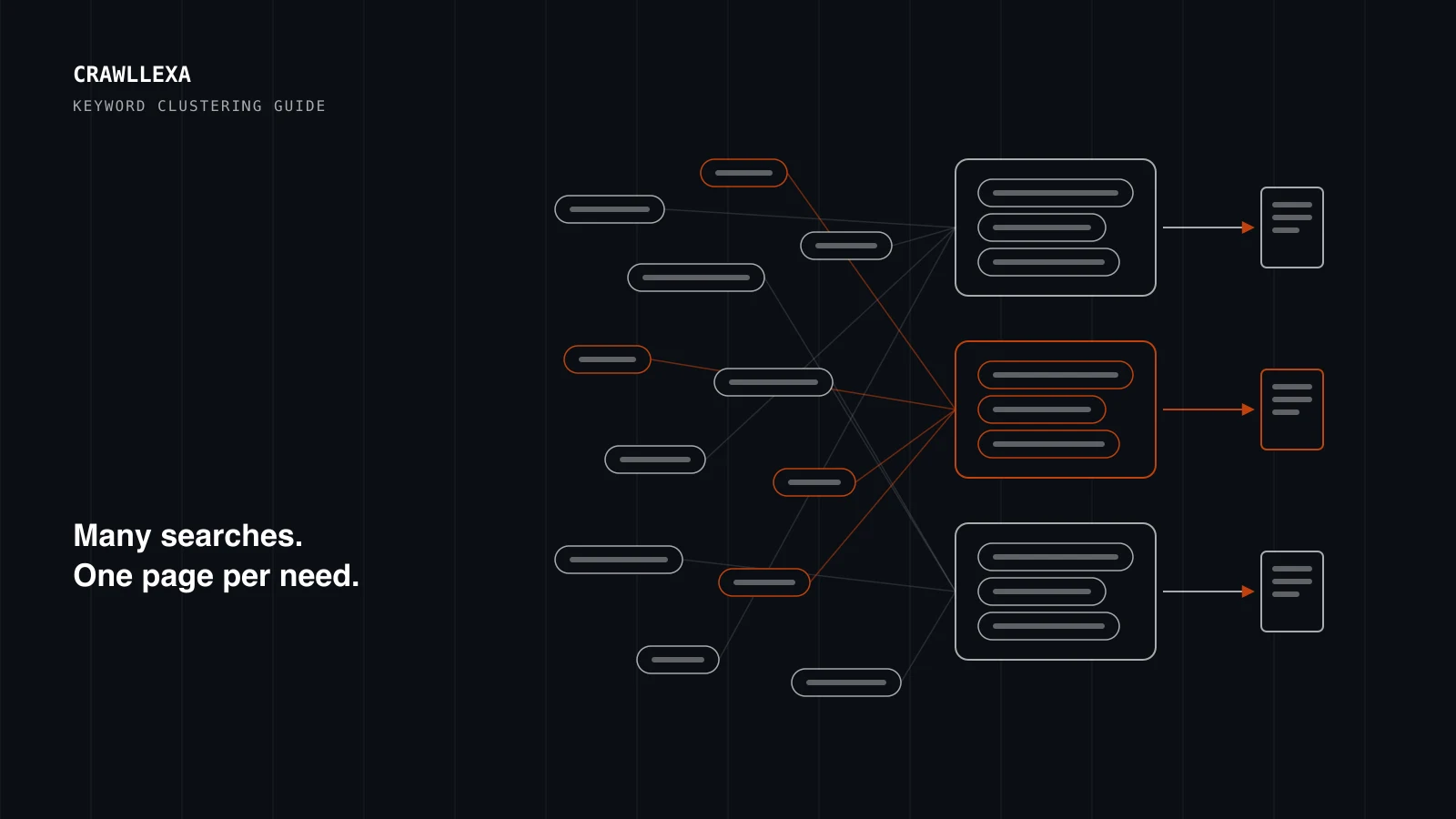
Keyword clustering is the step between keyword research and deciding which pages to build. You take a long list of searches and sort it into groups, where every keyword in a group wants the same thing, so that one page can serve the whole group. Done well, it turns thousands of keywords into a short list of pages you can defend, and it stops you from building five pages for one need.
Google described the problem neatly when it added Query groups to Search Console in October 2025. Its announcement listed eight ways people search for the same guacamole recipe, from “how to make guacamole dip” to “guac dip recipe”, and made the point that while these are distinct queries, they reflect a similar intent. Every keyword list has that pattern at scale: dozens of wordings, word orders and typos for each real question. Clustering is how you find the real questions.
This guide explains why clustering works, the three ways to do it and what each one misses, and a step-by-step process you can run on your own list, including with our free Keyword Grouper.
The short version
- One group, one intent, one page. Keywords belong together when the same page can fully satisfy all of them. Shared words aren’t enough; a shared need is.
- Search engines already treat variations as one need. Google’s systems match synonyms and related phrasings, so a page doesn’t need every variant in its copy, and you don’t need a page for every variant.
- A page for every wording backfires. Near-identical pages compete with each other, and Google’s spam policies treat substantially similar pages built for similar searches as doorway abuse.
- There are three ways to cluster: by shared words (fast and free), by shared search results (closest to how the search engine sees the queries, but paid) and by meaning (good with synonyms, weaker on intent). Use words for the first pass and search results for the groups that matter.
- Check intent before you commit. A group that mixes “how to” searches with “hire” or “buy” searches is two pages, not one.
- Map every group to one URL, starting with the pages you already have, and keep the map in a spreadsheet so new content doesn’t overlap old.
- Re-cluster with real data. Search Console shows which queries each page actually appears for. Use it to correct the plan every few months.
What keyword clustering is
A keyword cluster is a set of searches that one page can fully answer. Clustering is the work of finding those sets in a keyword list and deciding which page owns each one.
Keywords that look different often belong together:
- Different words for the same thing: “seo audit checklist”, “checklist for an seo audit” and “website audit checklist for seo”.
- Plurals, word order and typos, which search engines read as the same request.
- Modifiers that don’t change the need, such as a year, “online” or “guide”.
And keywords that look alike often don’t. Some modifiers change the need completely, and the same word can do either. “Free” barely matters for a keyword tool, because the tool is free either way. For “seo audit” it changes everything: a free audit and a paid audit service are different offers, and on our own site they’re two pages, a free SEO audit and our SEO audit services.
Keyword clusters aren’t the same thing as “topic clusters”, the content model where a broad guide links to narrower pages around it. Keyword clustering decides what each page is for; a topic cluster decides how those pages link to each other. You need the first to do the second well.
Why clustering works
Search engines match meaning, not just words
Google’s explanation of how it ranks results describes a synonym system that finds relevant documents even when they don’t contain the exact words searched. Its example: someone searches “change laptop brightness” while the manufacturer wrote “adjust laptop brightness”, and Search connects the two. Its guide to ranking systems adds that RankBrain helps it return relevant content “even if it doesn’t contain all the exact words used in a search”, and that neural matching connects the concepts in queries to the concepts in pages.
Google’s SEO Starter Guide puts the practical side plainly. Think about the words your readers use, since an expert might search “charcuterie” where a beginner searches “cheese board”, but don’t worry about anticipating every variation, because its language matching can relate a page to queries that don’t use its exact terms.
The implication is the whole case for clustering. You don’t need a page for every phrasing, and you don’t need every phrasing on the page. You need one strong page for each need.
Pages built for the same need compete with each other
Build two pages for one intent and they split the links, clicks and attention that one page would have earned, and they tend to take turns ranking with neither doing well. That’s keyword cannibalization. Extra pages rarely buy extra visibility either: Google’s site diversity system generally won’t show more than two listings from the same site in its top results, according to the same ranking systems guide.
A page per variation can cross into spam
Google’s spam policies define doorway abuse as pages created to rank for specific, similar search queries. Among the examples they list are pages targeted at individual cities or regions that funnel visitors to one page, and substantially similar pages that are closer to search results than to a clearly organized site. The same policies cover scaled content abuse: many pages generated mainly to manipulate rankings rather than to help anyone.
Google’s guidance on helpful content also asks whether you’re producing lots of content on many topics in the hope that some of it performs. A clustered plan answers that question before anything is written: every page exists because a distinct group of searchers needs it.
It turns a list into a plan
A keyword list tells you what people search for. A clustered list tells you which pages to build, which existing pages to improve, which needs you don’t cover yet, and how pages should link to each other. It’s also the cheapest cannibalization fix there is, because it happens before anything is published.
AI search raises the stakes. Google says AI Overviews and AI Mode may use a “query fan-out” technique, running multiple related searches across subtopics to build a response. A page that fully covers its group, including the questions that surround the main one, is relevant to more of those searches than a page written for one exact phrase. We cover this in more depth in our guide to AEO and GEO.
The three ways to cluster keywords
Every clustering method compares keywords somehow. What it compares decides what it gets right and what it misses.
| Method | What it compares | Good at | Misses | Cost |
|---|---|---|---|---|
| By wording | The words and phrases keywords share, after removing filler words and modifiers | Speed, very long lists, results you can follow and explain | Synonyms with no words in common, and look-alike keywords with different intents | Free; runs in a spreadsheet or a browser tool |
| By search results | How many of the same pages rank for each keyword | Reflecting what the search engine already treats as the same need, intent included | Nothing about meaning on its own; results shift by country, device and over time | Paid; one results lookup per keyword |
| By meaning | How close keywords are in meaning, measured by a language model | Synonyms, paraphrases, typos and other languages | Keywords that mean similar things but want different pages | Varies; built into some tools |
By wording
Wording-based grouping removes the words that don’t change the topic, such as “the”, “for”, “best” and “near me”, folds plurals together, and groups keywords by the most useful phrase they share. Our Keyword Grouper works this way: you paste a list or upload an export, and it returns topic groups with an intent tag for each keyword, without your list leaving your browser.
It’s fast, free and transparent: you can see exactly why two keywords landed together. Its blind spots come from the same place. “Cheap flights” and “low-cost airfare” share no words, so they won’t meet. “Seo audit” and “seo audit services” share almost every word but want different pages: one a guide, the other a provider. And a shared word can hide two meanings entirely, the way Google’s rater guidelines use [apple] as an example of a query that might mean the computer brand or the fruit.
By search results
Results-based clustering, often called SERP clustering, looks up the top results for every keyword and compares them. Two keywords are treated as one need when their results share enough of the same pages. You choose how many shared pages count as a match, usually out of the top 10, and a higher number gives smaller, tighter groups.
Tools differ in how strictly they apply the rule. Soft grouping compares every keyword against one anchor, usually the keyword with the most searches. Hard grouping requires every keyword in a group to match every other, which produces fewer, stricter groups.
This is the method closest to how the search engine itself sees your keywords, because a results page already reflects which need it thinks each query has. If guides rank for one keyword and service pages rank for another, they won’t cluster, even if they share every word. The drawbacks are cost, since every keyword needs its own lookup, and change: results differ by country, language and device, and they move over time, so a results-based cluster is a snapshot.
By meaning
Meaning-based clustering uses a language model to represent each keyword as a point in a “meaning space” and groups the points that sit close together. It’s how Google’s own Query groups work: the announcement says the groups are computed using AI, may change over time and don’t affect ranking, and that they’re only available to properties with a large volume of queries. Keyword Planner offers something similar for ads, with an option that auto-organizes keywords into ad groups for English keywords.
Meaning-based grouping is excellent at catching synonyms and rephrasings that wording misses. Its weakness is intent. Keywords can be close in meaning while wanting different pages, and the reasoning behind a group is hard to inspect.
Which one to use
Use them in layers. Group the whole list by wording, because it’s free and fast. Then check the search results for the groups that carry the most demand or value, and for any group that looks like it mixes intents. Finish with judgment, because no method knows which pages you already have, what you actually sell or which markets you serve.
How to cluster keywords, step by step
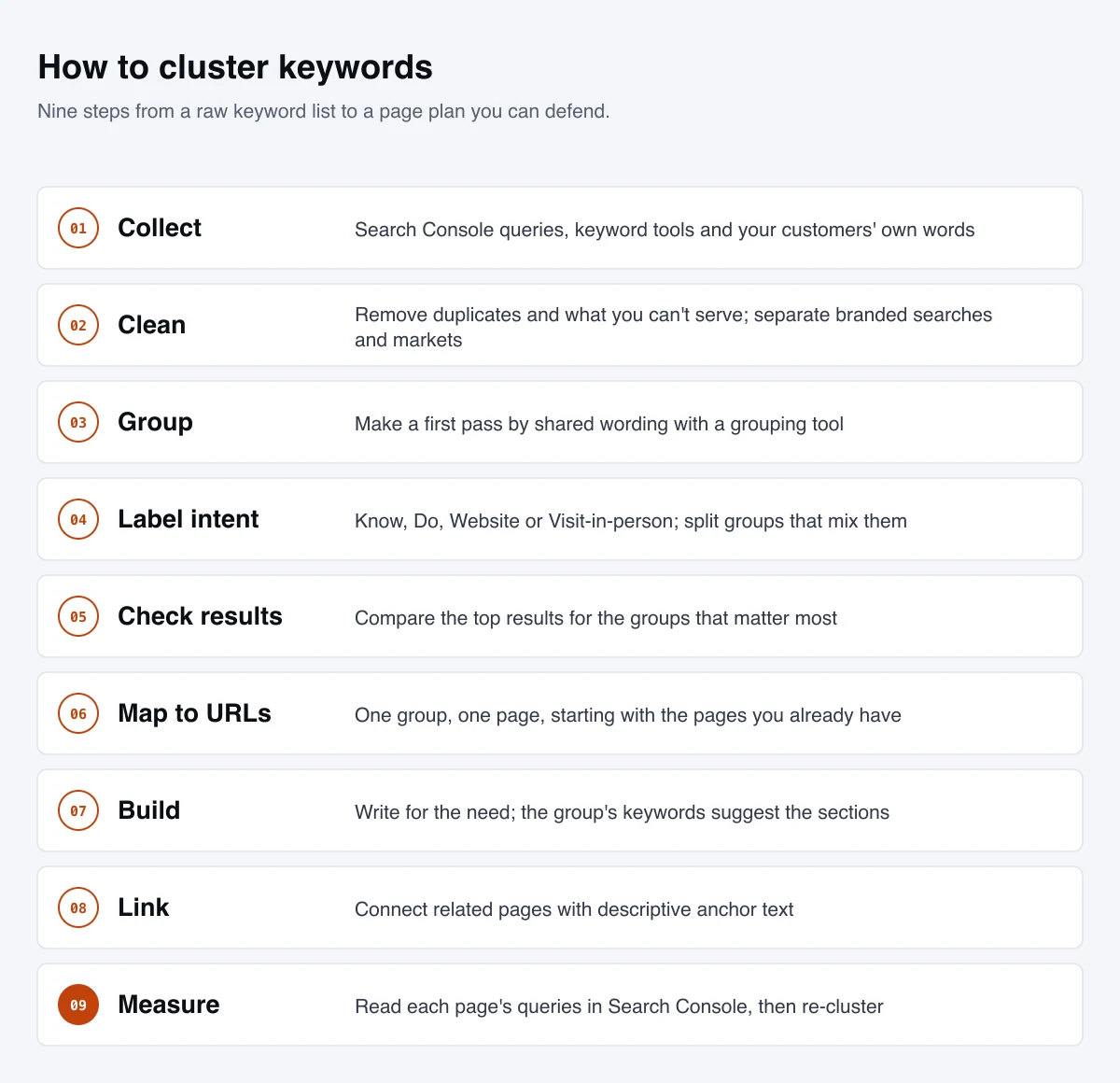
1. Collect keywords from more than one source
No single source sees everything, so combine a few:
- Search Console. The queries your site already appears for are the most valuable list you have, because they come with real impressions and clicks. The Performance report’s table and export stop at 1,000 rows. The Search Analytics API can return up to 50,000 rows per day per site per search type, according to Google’s deep dive on Performance data, and bulk data export to BigQuery isn’t subject to that daily limit.
- Keyword Planner and keyword tools for searches you don’t appear for yet, with volume estimates. Keyword Planner needs a Google Ads account with billing details set up.
- Your customers’ own words, from sales calls, support tickets, reviews and your site’s search box. They’re often the phrasings no tool suggests.
Search Console never shows everything. Queries that aren’t issued by more than a few dozen people over two to three months are left out to protect privacy, which hides much of the long tail. Treat it as a large sample, not the full picture.
2. Clean the list
- Normalize and remove duplicates: lowercase, trim spaces, and merge exact repeats, keeping the higher volume.
- Remove what you can’t serve: services you don’t offer, markets you don’t sell to, and keywords where the dominant meaning isn’t yours.
- Separate branded searches, both yours and competitors’. Searches for a specific brand want that brand’s site. Search Console’s branded queries filter splits your own branded and non-branded traffic automatically, for top-level properties with enough search volume.
- Separate markets and languages. A group of UK searches and a group of US searches may need the same page, or they may not. Decide deliberately.
3. Make a first pass by wording
Run the cleaned list through a grouping tool. In our Keyword Grouper, add your brand and competitor names so branded searches are tagged separately, choose how broad the groups should be, and set the smallest group size worth keeping. Treat the result as a first draft, not a plan.
4. Label the intent of each group
Google’s Search Quality Rater Guidelines describe four broad intents: Know (find information), Do (accomplish something, such as buy, download or book), Website (reach a specific site) and Visit-in-person (find a place nearby). SEO tools often split these further into informational, commercial, transactional and navigational. Use whichever labels you like, as long as every keyword in a group gets the same one.
Wording gives strong clues: “how”, “what” and “guide” suggest Know; “buy”, “price” and “hire” suggest Do; brand names suggest Website; “near me” suggests Visit-in-person. A group whose keywords carry different labels is usually two groups that happen to share words. Split it.
5. Check the results page for the groups that matter
For each high-value or doubtful group, search its two or three main keywords from the market you’re targeting and compare the top results:
- Several of the same pages ranking for both keywords means one page can serve both.
- Different kinds of pages, such as guides for one and service pages or tools for the other, means two pages.
- A mix of meanings in the results means the query has more than one common interpretation. The rater guidelines distinguish a dominant interpretation, which most searchers mean, from common and minor ones. Write for the one that matches your offer, and don’t expect to rank for the others.
6. Map each group to one URL
Start with the pages you already have. Filter the Search Console Performance report by a group’s main queries and see which page already earns impressions for them; improving a page that ranks is usually faster than publishing a new one. Create a new page only when nothing you have can serve the group well.
For each group, choose a primary keyword: the clearest phrasing of the need, usually the one with the most demand. Then record it in a simple map:
| Group | Primary keyword | Other keywords | Intent | URL | Status |
|---|---|---|---|---|---|
| Free audit | free seo audit | free website audit | Do | /seo-audit/ | Live |
| Audit service | seo audit services | seo audit company | Commercial | /seo/seo-audits/ | Live |
| Audit how-to | how to do an seo audit | seo audit checklist | Know | /blog/seo-audit-guide/ | Live |
One group gets one URL. One URL can own more than one small group if they share an intent, but never the other way around. Before you publish anything new, check the map; it’s the simplest cannibalization prevention there is.
7. Build or improve the page
Put the primary keyword in the title, the H1 and the opening paragraph, then write for the need, not the list. The other keywords in the group usually point to the sections a complete page needs: a group full of questions is a set of subheadings or FAQs waiting to be written. Google’s ranking systems include passage ranking, which identifies individual sections of a page to judge its relevance, so a well-structured page can be relevant to a narrower question within its group.
Don’t force every variant into the copy. Repeating keywords unnaturally is keyword stuffing, which the spam policies prohibit, and it makes pages worse to read. If you’re unsure whether a draft overdoes it, our Content Analyzer flags repeated phrases without chasing a keyword density target. Our on-page SEO guide covers the rest of the page, from titles to internal links.
8. Link the cluster together
Groups that share a parent topic form a natural hub: a broad guide links down to the narrower pages, and each of them links back up and across to close relatives. Use anchor text that describes the destination, so readers and search engines know what’s on the other side. This is where keyword clusters become topic clusters.
9. Measure and re-cluster
Give a page a few weeks after publishing or updating it, then filter the Search Console Performance report by that page and read the queries it appears for. Three things to look for:
- Queries from another group, which mean the page’s scope is wider or different from what you planned.
- Two of your pages trading the same query, which is cannibalization starting. Our cannibalization guide covers the fix.
- Groups with no page earning impressions, which are gaps to fill.
Re-run the clustering whenever you add a meaningful batch of new keywords, and review the map on a regular schedule. Quarterly suits most sites that publish often.
A worked example from our own site
In Search Console, our site appears for “keyword grouper”, “keyword grouper tool”, “keyword grouping tool”, “keyword grouper software” and “free keyword grouper”. Five wordings, one need: a tool that groups keywords. They belong to one page, and that page is our Keyword Grouper itself, not five landing pages with the words rearranged.
This guide serves a different need. Someone searching “how to cluster keywords” wants to learn the process, a Know intent, so it’s a separate page that links to the tool rather than competing with it.
The audit rows in the map above follow the same logic on a commercial topic. “Free seo audit”, “seo audit services” and “how to do an seo audit” share two words, but they’re three different needs: get a free review, hire a provider, and learn to do it yourself. Three intents, three pages.
When to split a group and when to merge
| Situation | Usually | Why |
|---|---|---|
| Same intent, and the results share several pages | One page | The search engine already treats them as one need |
| Same topic, different intent (learn, compare, hire, buy) | Separate pages | Each intent is won by a different kind of page |
| Synonyms, plurals, word order, typos | One page | Language systems match these to the same content |
| A question within a broader topic | A section or FAQ on the main page | Unless the question has results of its own, with different pages ranking |
| The same service in different cities | A separate page only where you genuinely serve that place | City pages with nothing local on them are a listed form of doorway abuse |
| Keywords where the main meaning isn’t yours | Drop them | You won’t rank, and traffic you did get wouldn’t convert |
Common mistakes
- Building a page for every variation. It splits signals, invites cannibalization and, at scale, looks like doorway pages.
- Stopping at shared words. Grouping by wording is a first pass. Without an intent check, “seo audit” and “seo audit services” end up on one page that serves neither well.
- Letting the tool decide. Every method makes mistakes in predictable places. The final call needs someone who knows the business.
- Mixing intents on one page. A page that’s half how-to guide, half sales page tends to rank for neither intent.
- Clustering keywords you can’t serve. Volume is tempting, but a group is only worth a page if your business can genuinely answer it.
- Clustering once. Search behavior, your site and the results all change. A map that’s never reviewed drifts into overlap.
Free ways to cluster keywords
You don’t need a paid tool to start:
- Our Keyword Grouper groups thousands of keywords by topic and tags intent, in your browser. It reads Search Console, Keyword Planner, Ahrefs and Semrush exports, and your list is never uploaded.
- Keyword Planner’s “Organize keywords into ad groups” auto-organizes a list into ad groups. It’s built for ads and works in English only, but the groups are a useful second opinion.
- Search Console’s Query groups show the main groups of searches already leading to your site, for properties with a large query volume.
- A spreadsheet with sorting and filters is enough for a few hundred keywords, and doing it by hand once teaches you how your market searches.
Where keyword clustering fits
Clustering sits at the start of a content strategy: research says what people search for, clustering says which pages should exist, and on-page work makes each page the best answer. It’s also the first thing we check when a site has plenty of content but little to show for it, because overlapping pages are one of the most common causes. If you’d like a second opinion on your own site, a free SEO audit is the place to start.